

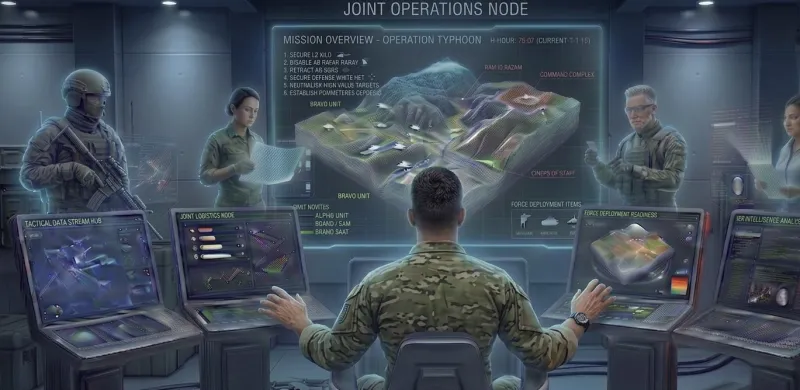
AI Isn’t the Future of Combat. It’s Already in the Loop
The real shift in combat is not autonomy but understanding: meet the agents that make systems explain what’s happening rather than simply show it.
On paper, modern battlefields are saturated with information. In practice, they often feel like the opposite. Operators sit in front of multiple systems, each doing its job and producing data, yet still find themselves asking the same question: what actually matters right now?. The gap lies not in collection, but in interpretation.
At Elbit Systems, a growing effort around what is internally referred to as Genforce Combat AI aims to close that gap by reorganizing how data is understood, connected, and ultimately turned into action.
The systems themselves are not new. Years of development across unmanned platforms, robotics, and C4I have created an ecosystem that continuously generates information at scale. What is changing is how that information is structured. Instead of presenting operators with fragmented inputs, the goal is to build a coherent narrative that explains not just what is happening, but what it means in context.
“We already have the data,” says Ami, a Senior Director in the C4I and Cyber Division. “The question is how to organize and contextualize it so the AI Agent can actually understand the situation you’re in.”
From that point of view, Combat AI is less about adding another layer of technology and more about making sense of what already exists. It operates above sensors and systems, connecting them into something that behaves less like a dashboard and more like a reasoning engine. The ambition is to move from displaying information to explaining the operational meaning, and from explanation to recommending action.
From Systems to Stories
This shift changes how operators engage with the battlefield. Traditional systems relied heavily on predefined rules and scenarios, requiring users to know where to look and how to interpret what they saw. The newer approach aims to reduce that dependency by making interaction itself more intuitive. Interfaces increasingly resemble conversational systems, allowing users to query the environment rather than navigate it step by step
“Operators should be able to obtain answers intuitively, without mastering every subsystem,” Ami explains. “The system needs to meet you where you are.”
Beneath that interface sits a more complex structure built around AI agents. Each agent represents a specific domain of expertise – communications, radar, logistics, maneuver – and continuously analyzes incoming data within that context. Instead of forcing a human operator to manually fuse these perspectives, the system performs that integration in parallel, producing a more complete and dynamic picture. The result is not a single answer but a set of informed recommendations shaped by multiple layers of analysis.
This matters because of the sheer volume and diversity of modern data. Information now arrives as video, audio, text, and signals, often simultaneously and at high velocity. Recent technological advances have made it possible to process these different modalities together, reducing error rates and enabling deeper analysis. “Today you can take speech, video, text – everything – and analyze it together,” says Ami. “That’s what allows you to reach a much deeper understanding.”
From Analysis to Cognition
As systems begin to understand context rather than simply process inputs, the boundary between analysis and decision-making begins to shift. AI is no longer limited to identifying patterns; it begins to suggest courses of action. This opens the door to higher levels of autonomy, particularly in robotics and unmanned systems, where machines can operate more independently when supported by a clearer understanding of their environment.
At the same time, this shift addresses one of the most persistent challenges in modern operations: information overload. Combat AI introduces a layered approach in which data is filtered, structured, and analyzed before it reaches the operator. “There’s too much information and too many people dealing with it,” Ami notes. “The goal is to distill it into something that actually helps you make a decision.”
This distillation process relies on a chain of AI agents that function almost like a digital staff, each responsible for a specific aspect of the analysis. Together, they form what can be thought of as a distributed system of expertise capable of handling everything from tactical engagements to logistical planning. The operator, at the end of that chain, receives not raw data but a refined output designed to support decision-making.
Building the Engine Beneath
Behind this capability lies a significant engineering effort. Data must be collected, labeled, and structured before it can be used effectively. Features must be extracted, models trained, and prompts designed to align outputs with operational needs. This process spans multiple layers, from raw data ingestion to high-level reasoning, each requiring careful calibration.
Deployment adds another layer of complexity. Systems must function across centralized command environments as well as resource-constrained edge platforms, where computational power and energy are limited. This requires continuous optimization, balancing model size, latency, and performance.
Efficiency becomes an important metric in this context. Computational resources are no longer abstract; they translate directly into operational constraints. Managing them effectively is part of the system design, influencing everything from architecture to real-time performance.
Keeping Humans in the Loop
For all its technological ambition, the system is designed with a clear understanding of its limits. Human expertise remains central, not as a fallback but as an integral part of the process. AI agents are built to reflect operational knowledge, but operators remain responsible for validating, interpreting, and ultimately making decisions.
This preserves accountability and aims to ensure decisions remain explainable and ethical. Recommendations need to be transparent, explainable, and grounded in data that operators can understand. Without that, adoption becomes difficult, regardless of the system’s capabilities. “You need to be able to explain why the system is suggesting something,” Ami says. “Explainability is what turns automation into trust — and trust into adoption.”
The interaction that emerges is not one of replacement but of collaboration. Humans and machines operate in parallel, each contributing different strengths to the same decision-making process. The system reduces cognitive load and expands analytical capacity, while the operator provides judgment, context, and accountability.
Together they create augmented decision making — revealing that the future of warfare may be where machines extend our reach, but humans preserve our wisdom.