Artillery’s Enduring Power in Modern Warfare
Artillery has long been regarded as the "King of Battle," a title earned through centuries of shaping the outcomes of conflicts.
From the ancient Roman Onagers, Ballista and the Chinese cannons to the thunderous cannons of the Napoleonic Wars to the precision-guided capable systems like the SIGMA and PULS™ rocket artillery system of today, artillery remains a cornerstone of military strategy.
The evolution of artillery has transformed the battlefield, especially in the last century due to the leaps of science and engineering. It has been transformed from a blunt instrument of destruction into a sophisticated, high-tech force multiplier that no military can be without.
Ancient Origins
The concept of artillery long predates the invention of gunpowder and goes back millennia to the peak of the Roman empire.
In the ancient world, the Romans were among the first to deploy large-scale mechanical weapons capable of delivering force over long distances. The Romans were masters of siege warfare, and they used torsion-powered weapons like the ballista and the onager to hurl large bolts and stones at enemy fortifications. Roman military engineers refined these devices to such a degree that they became integral to the success of Roman campaigns across Europe, North Africa, and the Middle East.
These machines, though primitive by modern standards, laid the conceptual groundwork for today’s artillery: to destroy, suppress, and demoralize the enemy from a distance, and to support the maneuvering echelons as they engage the enemy.
The Gunpowder Revolution and Industrial Precision
The true transformation of artillery began with the invention of gunpowder in China during the 9th century and over the following centuries evolved into more powerful and reliable weapons. During the late medieval and early Renaissance periods, cannons became essential in siege warfare, capable of breaching the once-impregnable stone walls of castles and fortresses. During the Napoleonic Wars, artillery became more mobile and tactically integrated, setting the stage for its dominant role in future conflicts.
The industrial age brought further refinement. Artillery as we know it today can be traced to the beginning of the 20th century during the Russian-Japanese war in 1904 when the Russians used indirect fire to target enemy forces. In World War I, artillery was the dominant force on the battlefield as the war introduced indirect fire, creeping barrages, and counter-battery tactics that defined the brutal nature of trench warfare.
World War II expanded on these innovations with self-propelled guns and more mobile systems, allowing artillery to support fast-moving armored divisions across vast theaters of war.
The Digital Battlefield and Precision Firepower
The technological advancements of the last hundred years have revolutionized artillery.
Digital fire control systems have replaced manual calculations, enabling faster targeting and integration with other systems and reconnaissance assets. Innovations such as computing that have enabled much faster fire data calculations, GNSS and inertial navigation that enables fast and accurate self-locating and target locating, better ammunition with increased lethality and longer barrels that have extended the range of artillery far beyond traditional limits, allowing forces to strike deep into enemy territory.
Modern artillery systems are also far more mobile, with self-propelled and wheeled platforms capable of rapid deployment and repositioning, a critical advantage in high-threat environments. Furthermore, artillery is now deeply embedded in network-centric warfare, receiving real-time data from satellites, UAVs, and ground sensors to engage targets with unprecedented speed and accuracy.
T, a senior executive at Elbit Systems, explained that one of the main differences between historical battlefields and modern ones is mobility.
"In the past, there were towed Howitzers, and it was complicated and hard to move them. It took a lot of time, effort and people. You usually needed another vehicle to tow the Howitzer. We have now moved from towed to tracked and now wheeled howitzers and rocket artillery."
Along with mobility, T explained that artillery has undergone two other major transformations in recent decades: enhanced firepower and the integration of advanced electronic suites that have transformed artillery into a networked asset.
"Another impactful change is the shift from manual to automated loading systems," T said, adding that "in the past, loading 40-kilogram shells was physically demanding and limited the rate of fire. Today, semi-automatic and robotic loaders have increased firing speed, reduced crew fatigue, and opened artillery roles to a more diverse range of soldiers."
Another key advancement is the upgrade from 39-caliber to 52-caliber barrels, now standard in systems like Elbit Systems' ATMOS and SIGMA. This longer barrel allows for greater range—up to 40 kilometers without rocket assistance, making artillery more effective in deep-strike roles.
Europe Is Racing to Rebuild Its Artillery Forces
The war in Ukraine has served as a brutal reminder of the enduring importance of artillery in large-scale, high-intensity warfare. The conflict has seen artillery return to the forefront of combat, not as a relic of past wars, but as a decisive tool in modern operations.
According to T, with its versatility and rate of fire, artillery "gives confidence to troops."
"The artillery gun gives the advantage where it can be in one position and support troops 15km away and two minutes later, it can support troops 30km away in another direction," he said.
“If you ask any infantry soldier whether they’d go into battle without artillery support, not a single one would say yes,” says T. “Every one of them will tell you that without artillery laying down fire beforehand, they won’t step onto the battlefield.”
He explained that the importance of artillery is often underestimated during peacetime.
“When you’re not actively firing, it’s easy to cut the budget. There’s no visible urgency. But after every war, the demand for artillery becomes crystal clear. You quickly realize that no maneuver is possible without artillery support at the outset.”
This resurgence has exposed a critical vulnerability in European defense planning. For decades, many NATO countries reduced their artillery inventories and ammunition stockpiles, assuming that large-scale land wars on the continent were a thing of the past.
The Ukraine conflict changed that perspective.
According to Ukrainian numbers, Russia has lost 28,090 artillery systems since Moscow invaded in February 2022. Since the start of the conflict, the West has delivered over 620 artillery guns to Ukraine, along with various missile systems.
European militaries quickly discovered that their existing stocks of 155mm shells and other key munitions were insufficient for sustained operations. The war’s intensity—marked by daily artillery duels and massive consumption of shells—has forced a fundamental reassessment of military readiness.
The lessons from the conflict in Ukraine have spurred global militaries to rethink not only their defense strategies and increase procurement, but they are rethinking their artillery strategies and are stocking up on new modern artillery systems.
“You simply can’t replace artillery,” T emphasizes. “At the end of the day, artillery shells are just metal, they are cheap but incredibly effective. It’s the volume that makes the difference. Imagine a thousand rounds hitting a single area—nothing survives that.”
“After almost every military operation or war, the importance of artillery becomes undeniable,” T emphasized. “When that realization comes, there’s a renewed understanding that artillery isn’t just useful, it’s essential. It’s been that way throughout history.”
The Vanguard of Artillery Innovation
With Ukraine continuing to show the importance of artillery, Elbit’s artillery systems have seen a surge in international demand.
In 2024 the Company secured a $57 million contract to supply the PULS to Germany as well as a separate $335 million contract to supply PULS rocket launchers and Hermes 900 Unmanned Aerial Vehicle (UAV) to a European country. In 2023 Elbit secured contracts in the European markets for the PULS and ATMOS (Autonomous Truck Mounted Howitzer System).
According to T, Elbit Systems "is not a small player" in the world of artillery.
"We are flexible and creative and that has allowed us to meet customer requirements. We design the core weapons station and all the rest can be adapted to customer needs, such as the truck and C4i system," T said.
Another key strength, he said, is Elbit's advanced fire control system.
“This system is essentially the central computer that manages everything from traverse and maintenance to firing and it is built on an open architecture. That means every customer can integrate their own C4i systems. We provide the necessary interfaces and protocols, ensuring full compatibility. From our side, everything is open and ready for integration.”
Elbit's platforms also fully support the use of smart ammunition on the battlefield, including course-correcting fuzes and advanced guided projectiles.
"These technologies bring a level of precision that was once unheard of in traditional artillery," T said, explaining that in the past, achieving accuracy required firing multiple rounds and adjusting based on impact. "Now, with smart munitions, a single shot can hit its target with remarkable precision. It’s nothing short of a revolution in artillery, and all of our systems are designed to be fully compatible with these advanced capabilities.”
C, another senior Elbit official, has been around artillery since joining the IDF and rose through the ranks during his military career while simultaneously working at Elbit Systems.
"Artillery is such an effective and devastating force that some 60-70% of casualties in wartime are due to artillery," C said.
Due to that, "artillery is a prime target and the batteries have to move in order to survive. As tech advanced with radars that can locate the areas where projectiles were fired, artillery is hunting the other side's artillery," C continued, adding that "staying around after firing has led them to being hit quite quickly and that brought into life the term 'shoot and scoot' that means-you fire, and you move out of harm's way. And the speed in which you move relies on technology."
According to C, Elbit "brought the 'system of systems' approach to the artillery domain," after the company sold its first large scale C4i system to a European customer in the 1990s. The system took data and other parameters and sent the information to the guns.
With the rise of computing power, artillery systems advanced rapidly—calculations became faster, barrels grew longer, and overall performance improved. However, C stressed, this technological leap came with a "steep learning curve."
Elbit Systems later acquired an Israeli company specializing in guns and mortars and quickly recognized the strategic advantage of high-mobility artillery on wheeled platforms over traditional tracked vehicles. This important decision aligned with global trends, as wheeled systems gained popularity and led to a wave of contracts around the world.
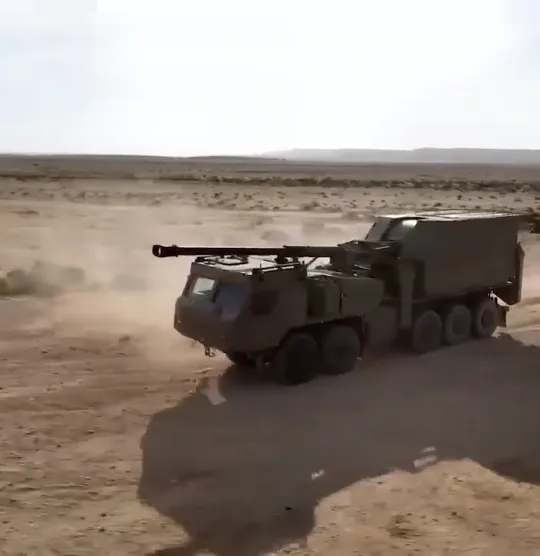
According to T, all of Elbit's artillery systems are wheeled, including the Sigma, Elbit's first fully automated 155mm/52cal truck mounted gun. SIGMA is mounted on a high-mobility 10x10/8x8 platform and has a fully automatic, remote-controlled self-contained turret featuring auto-laying and auto-ammunition loading capabilities.
Equipped with software-based AI technology, it can fire the first shell within 40 seconds of halting and has a maximum firing rate of over 8 shells per minute. SIGMA offers enhanced safety for operators, who will be stationed inside the armored truck cabin and requires only a three-person crew- a mission commander, gunner and driver.
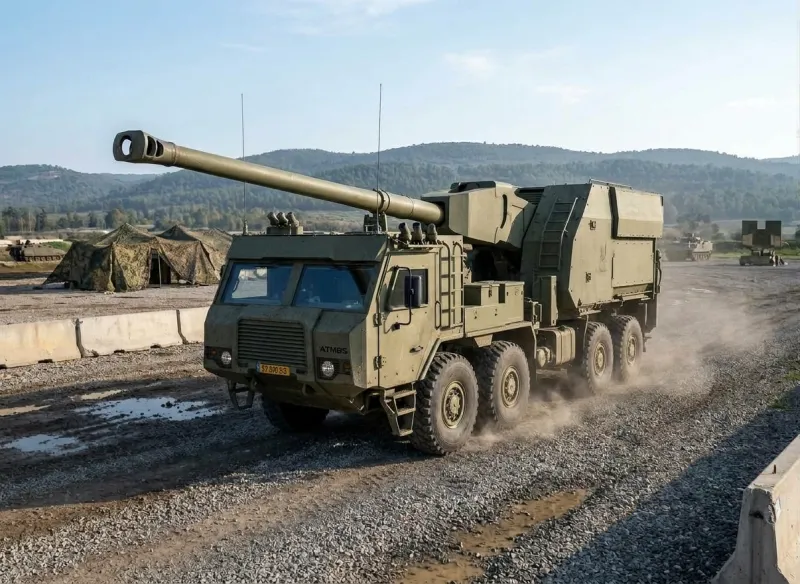
The ATMOS (Autonomous Truck Mounted Howitzer) modular artillery system is a combat proven wheeled Howitzer solution, capable of firing all NATO-certified 155mm projectiles that has an effective range of over 40km with standard projectiles and offers extended range with Rocket-Assisted Projectiles (RAP). Onboard containers store a minimum of 18 rounds, including projectiles, propellants and fuses.
It is designed for rapid deployment and operation enabling provision of fire support for a broad range of missions. Designed specifically for rapid deployment and operation on difficult terrain, the ATMOS semi-automatic gun is operational in artillery forces around the world. These systems, C said, "are a tremendous leap."
The future
With various conflicts highlighting the importance of artillery fire, China is reported to be converting its ground-launched rocket artillery into low-cost, air-targeting precision gliders.
Called the Tianxing-1, the guided munition features is launched at an angle from ground-based platforms. With wings and adjustable tail fins for extended range and powerless-flight maneuverability, the platform transitions into a glide phase before engaging targets.
But China isn't the only one that is looking at the future of artillery by coupling loitering munitions with rocket launchers.
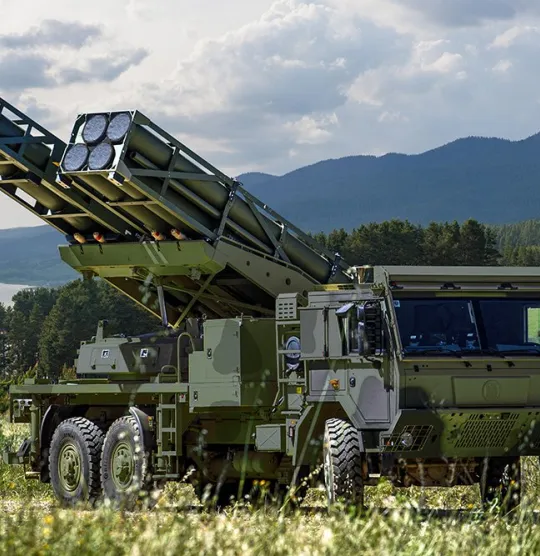
Elbit Systems' Precise and Universal Launching System (PULS) can launch various types of munitions, including free-flying rockets and precision guided rockets and missiles ranging from 12km and up to 300km with variations of available warheads. It can also launch the SkyStriker loitering munition from a ground pneumatic launcher or from a canister integrated onboard the PULS.
This synergetic precision fire capability with the Skystriker significantly expands the operational envelop of artillery forces providing them with organic ISTAR and airborne strike capabilities to a range of up to 100km.
While artillery is still mostly about statistical fire, precision-guided munitions can also allow for pinpoint strikes using GPS and laser guidance, aimig to reduce collateral damage while increasing lethality.
The King Still Stands
While the modern battlefield is increasingly shaped by drones, cyber capabilities, and precision airpower, artillery remains an indispensable pillar of military strength.
From Roman siege engines to precision rocket systems like Elbit’s PULS and the fully automatic SIGMA, artillery has continuously evolved to meet the demands of modern warfare. Its combination of firepower and versatility ensures that artillery continues to shape the course of conflicts. As warfare becomes more complex and multi-domain, the demand for precise, networked, and rapidly deployable fire support will only intensify.
With cutting-edge innovations and industry leaders driving its evolution, artillery is not just surviving the digital age, it is thriving. The "King of Battle" stands as a formidable force for the future.