

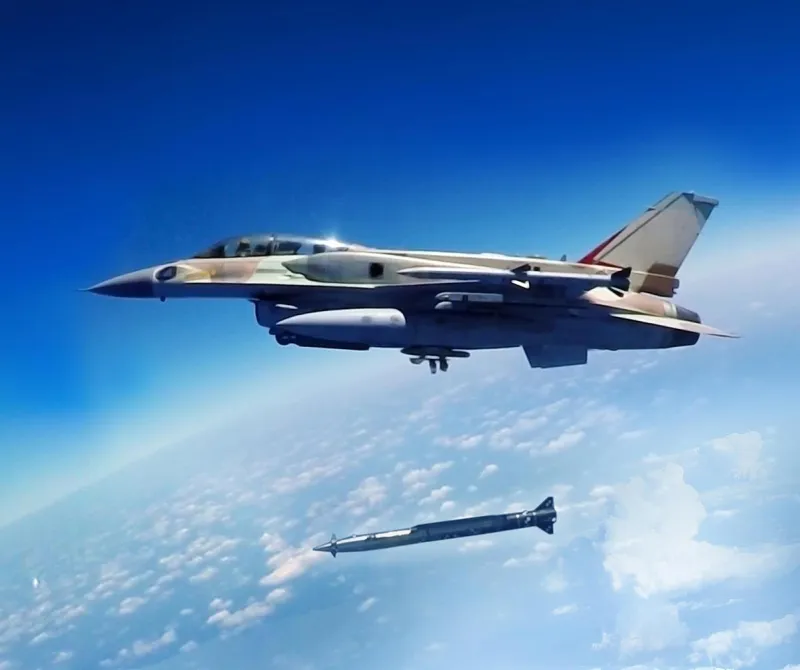
How Far Away Can You Strike?
As air defenses push aircraft farther from their targets, the challenge is no longer simply hitting accurately. Air forces need to strike from a distance, penetrate complex defensive environments, and do it fast. Rampage was built around that equation.
Key Takeaways
- Rampage is a long-range, supersonic air-to-ground precision strike missile.
- GPS/INS navigation with anti-jamming capabilities.
- The missile enables stand-off strikes while allowing aircraft to remain farther from hostile air defenses.
- Its fire-and-forget architecture supports rapid response and salvo strikes against high-value targets.
- The Rampage is combat-proven and mission-ready, and the missile is designed for integration with a range of combat aircraft.
For decades, the basic logic of an air strike was straightforward: get the aircraft close enough to the target, release the weapon, and rely on precision to do the rest. Modern air defense has complicated that equation.
As surface-to-air systems become more capable and defended areas grow larger, the distance between an aircraft and its target has become a critical part of mission planning. A precision weapon is no longer defined only by how accurately it arrives. Increasingly, it is also defined by how far away the aircraft can remain when the weapon is launched.
That is the environment Rampage was designed to address. Rampage is a long-range, supersonic air-to-ground precision strike missile designed for stand-off operations. Rather than forcing an aircraft to approach heavily defended areas, the weapon can be released from a distance and continue toward its target autonomously. Elbit Systems describes the missile as a combat-proven, mission-ready weapon designed for rapid response and salvo strikes against high-value targets.
A Different Kind of Air-Launched Weapon
Rampage weighs 610 kilograms and stretches 4.7 meters from nose to tail, with a diameter of 306 millimeters. Once launched, its supersonic flight profile gives a defending force less time to detect, assess, and respond to the incoming threat.
But speed is only one part of the design. Rampage uses GPS/INS navigation combined with anti-jamming capabilities, providing resilience in environments where satellite navigation may be deliberately disrupted. It is also a fire-and-forget weapon, meaning that after launch, the aircraft does not need to continuously guide the missile toward its target.
The result is a weapon designed around operational independence: launch from stand-off distance, leave the immediate threat environment, and allow the missile to complete the mission autonomously.
For air forces facing increasingly dense air-defense networks, that changes more than the weapon itself. It changes the options available to the aircraft carrying it.
From the Ground to the Air
The missile was originally unveiled in 2018 as a joint development between Israel Aerospace Industries and IMI Systems. Later that year, Elbit Systems completed its acquisition of IMI, bringing its munitions and rocket capabilities into Elbit Systems Land.
The air-launched concept draws on technologies developed for ground-launched rocket systems, but moving the weapon onto a fighter aircraft fundamentally changes the geometry of the mission.
Precision Under Electronic Attack
Long-range precision increasingly depends on something that cannot be taken for granted: navigation. Electronic warfare has made interference with GPS and other satellite-navigation systems a standard feature of modern conflict. A weapon that performs accurately in ideal conditions but loses that precision once jamming begins has limited value in exactly the environments where stand-off weapons may be needed most.
Rampage therefore combines GPS and inertial navigation with anti-jamming technology. Its published accuracy is a 10-meter CEP, while Elbit describes the weapon as capable of all-weather, day-and-night operations.
One Missile, Different Aircraft
A sophisticated weapon is only useful if it can actually be integrated into the air force that needs it. Rampage was therefore designed to work with a range of combat aircraft. It can operate as a stand-alone system or be integrated more deeply into aircraft avionics, depending on the platform and customer requirements. Its interface also enables multiple missiles to be carried by a single aircraft.
That flexibility matters because air forces rarely begin with a blank sheet of paper. They already operate aircraft fleets, avionics, weapons-management systems, and logistical infrastructure built up over decades.
A weapon that can fit into that ecosystem without requiring an entirely new aircraft or operating concept can shorten the path from acquisition to operational capability.
Built for the Targets That Cannot Wait
Rampage is intended for missions where distance, speed, precision, and timing converge: strikes against high-value fixed or time-critical targets, including protected military infrastructure and air-defense-related targets. Its available warhead configurations include general-purpose, blast-fragmentation, and penetration options.
It can also approach at an impact angle of up to 90 degrees, giving the weapon a near-vertical terminal attack profile when required. Published impact velocity ranges from 350 to 550 meters per second.
Together, these characteristics position Rampage in a particular part of the precision-strike spectrum: heavier than small tactical weapons, faster than many conventional stand-off solutions, and designed for missions in which the launch aircraft needs to remain outside the most dangerous portion of the enemy's defensive envelope.
Why Stand-Off Strike Matters More Than Ever
The modern air campaign is becoming a contest of reach. Air-defense systems seek to push aircraft farther away. Electronic warfare seeks to interfere with the weapons they launch. Mobile and time-sensitive targets compress the time available to act. At the same time, commanders are expected to achieve precise effects while limiting the exposure of aircraft and crews.
These pressures can appear contradictory. Greater distance can make precision and responsiveness more difficult. Greater protection for the aircraft can reduce the number of available attack options. Rampage's combination of supersonic speed, autonomous operation, precision navigation, anti-jamming capability, and platform flexibility reflects a broader shift in airpower: the weapon is increasingly expected to carry more of the risk so that the aircraft does not have to.
And as defended airspace becomes more complex, that distance between aircraft and target may prove to be one of the most valuable capabilities of all.
Key Specifications
Weight: 610 kg
Length: 4.7 m
Diameter: 306 mm
Guidance: GPS/INS with anti-jamming capabilities
Accuracy: 10 m CEP
Impact Velocity: 350-550 m/sec
Impact Angle: Up to 90°
Warheads: General Purpose, Blast Fragmentation, or Penetration
Operation: Fire-and-forget, all-weather, day/night
FAQ
What Is the Rampage Missile From Elbit Systems?
Rampage is a long-range, supersonic air-to-ground precision strike missile offered by Elbit Systems. It is designed to enable combat aircraft to engage high-value targets from stand-off distances while combining high speed, precision navigation and resistance to electronic jamming. The system originated as a joint development by IMI Systems and Israel Aerospace Industries; IMI was acquired by Elbit Systems in 2018.
How Does Rampage Maintain Precision in a Jammed Environment?
Rampage combines GPS and inertial navigation, or INS, with anti-jamming capabilities. This architecture is designed to provide greater navigation resilience in environments where satellite-navigation signals may be disrupted.
Why Is Rampage Considered a Stand-Off Weapon?
Rampage is designed to be launched while the aircraft remains at a significant distance from the target and hostile air defenses. Its high speed and autonomous fire-and-forget operation allow the missile to continue toward the target after release without requiring continuous guidance from the launch aircraft.
Can Rampage Be Integrated with Different Fighter Aircraft?
Yes. Rampage was designed for integration with a variety of combat aircraft and can operate either as a stand-alone system or through integration with an aircraft's avionics. The system also supports carrying multiple missiles on a single aircraft.
Is Rampage Combat-Proven?
Elbit Systems currently describes Rampage as a combat-proven and mission-ready weapon. The company continues to present the system internationally as part of its long-range precision-strike portfolio.
Important Notice: Certain blog articles may contain forward-looking statements and are not intended to provide business, financial, or investment information. Please review our full disclaimer here.


