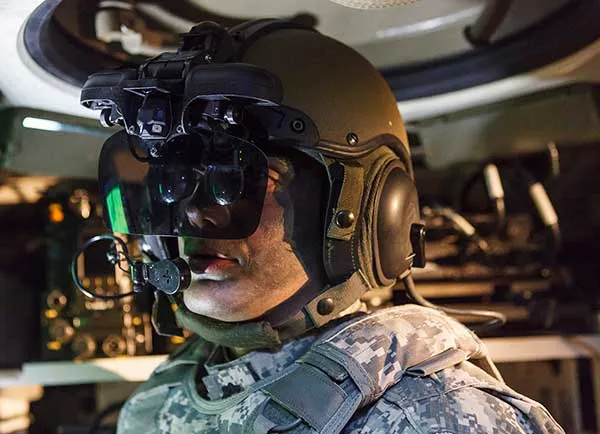
IronVision™: Seeing Through Armor Without Leaving Protection
Real-time visuals, layered data, and faster targeting: the Iron Vision system is designed to increase crew survivability without sacrificing awareness.
The moment a tank commander opens a hatch to get a better look, the trade-off is immediate. Visibility improves, but protection drops. For decades, crews have had to navigate that compromise instinctively, balancing what they can see against how exposed they are. Systems such as IronVision are designed to help remove that decision altogether, keeping crews sealed inside while expanding their view beyond what was previously possible.
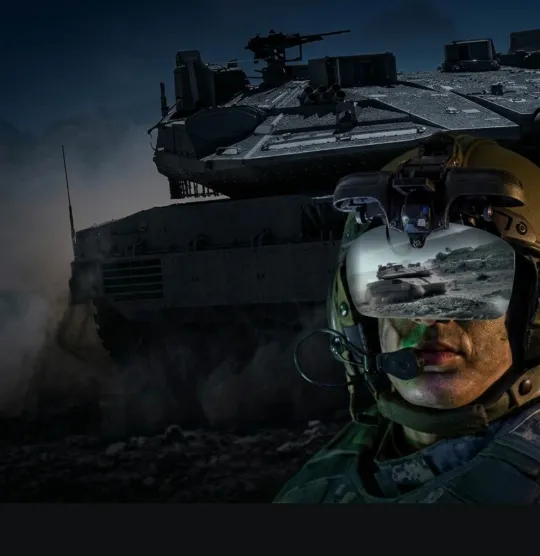
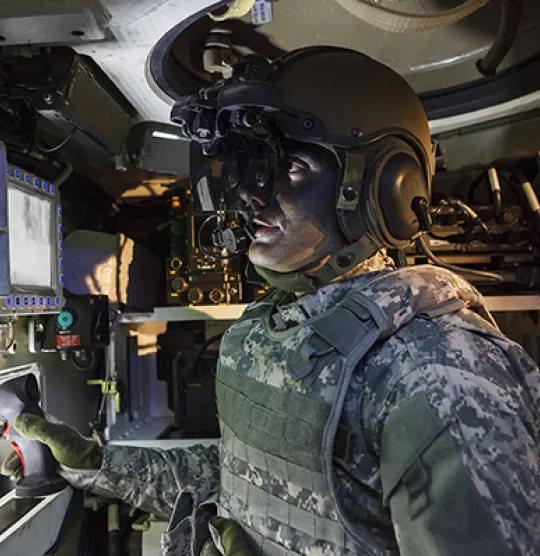
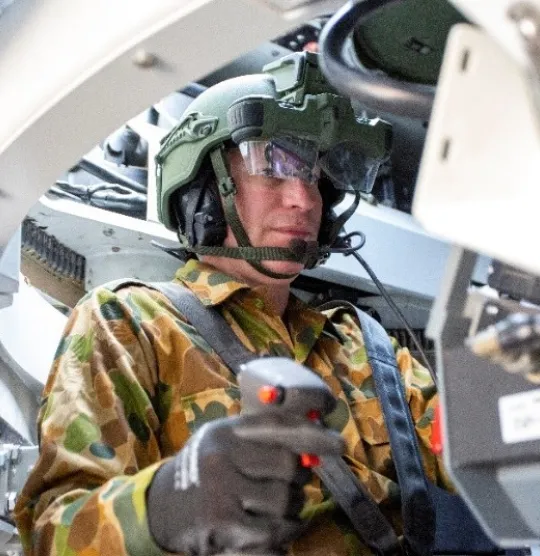
IronVision, developed by Elbit Systems, is a helmet-mounted situational awareness system for armored fighting vehicles. IronVision is a helmet-mounted situational awareness system for armored fighting vehicles. Using a network of externally mounted cameras, it aims to provide commanders, drivers, and crew members with a real-time 360-degree view of their surroundings while remaining protected inside the vehicle.
Engineering Meets Operational Reality
For Adiel, managing the IronVision™ program within a business unit focused on international markets means operating at the intersection of engineering, operations, and customer engagement. “It’s a role that touches everything,” he explains. “You’re in constant dialogue with system engineers, production teams, and customers. You’re connecting all the pieces into something coherent.”
That breadth is unusual, particularly for Adiel, who currently holds a student program manager position while completing an electrical engineering degree. Program managers in this domain typically arrive with years of operational or engineering experience. Yet the exposure it provides is equally uncommon: direct visibility into complex programs, some valued in hundreds of millions of dollars, alongside hands-on involvement in technical, logistical, and commercial decision-making.
Seeing Without Exposure
By projecting a real-time, 360-degree view onto the commander’s helmet visor, the IronVision system allows commanders to detect and track threats without leaving the protection of the vehicle. Objects identified by onboard sensors can be highlighted and overlaid directly onto the operator’s field of view, reducing the cognitive burden of interpreting multiple data streams.
"The system is designed not only to present information but also to shorten the decision-making process", says Oren, the leading IronVision system engineer. The system is designed to support rapid target engagement by improving the interaction between crew members and providing automated cueing functions that help crews detect, understand, and respond to threats more quickly. In such a configuration, a commander could designate a target through the helmet interface, with the system aligning the weapon accordingly. This reduces manual input, accelerates engagement, and minimizes the time between detection and response.
Reducing Load, Expanding Capability
Modern armored crews operate in increasingly complex environments, where information density can quickly overwhelm even experienced operators. Iron Vision’s design philosophy focuses on filtering and presenting only what is operationally relevant when it is needed.
The system’s utility extends across multiple roles within the vehicle. For drivers, it provides enhanced visibility in both day and night conditions, supporting navigation in constrained or unfamiliar terrain. Obstacles, terrain features, and potential hazards become easier to identify, reducing the risk of accidents or exposure to hidden threats such as improvised explosive devices.
Meeting Operational Demands in Complex Environments
Armored vehicle crews are frequently required to operate in conditions where visibility is limited, and threats can emerge at very short range. Urban environments, night operations, loitering UAVs and close coordination with infantry create additional challenges for both commanders and drivers.
For commanders, maintaining situational awareness while remaining under armor is critical when operating in areas exposed to snipers, fragmentation threats, and rapidly changing tactical conditions. The ability to observe activity around the vehicle without opening the hatch helps improve protection while supporting faster decision-making.
For drivers, continuous visibility beyond the vehicle's traditional field of view can help identify obstacles, terrain hazards, and nearby personnel during day and night operations. Improved awareness can reduce dependence on verbal instructions from the commander and support safer maneuvering in complex terrain.
The system also supports closer coordination between vehicle crews and infantry forces operating nearby, helping crews monitor soldiers moving alongside the vehicle and identify potential threats approaching from short range.
From Development to Deployment
As Oren mentions, " IronVision has been under development for close to a decade, with continuous upgrades and refinements introduced along the way by users from the IDF". The system is currently operational with the Israel Defense Forces (IDF) and is with growing interest from additional markets. Various countries have shown interest, while upcoming demonstrations aim to expand its footprint further.
A key factor in Iron Vision’s adoption is its relative ease of integration. The system is designed to be platform-agnostic, capable of being installed on a wide range of armored vehicles without requiring extensive structural modifications.
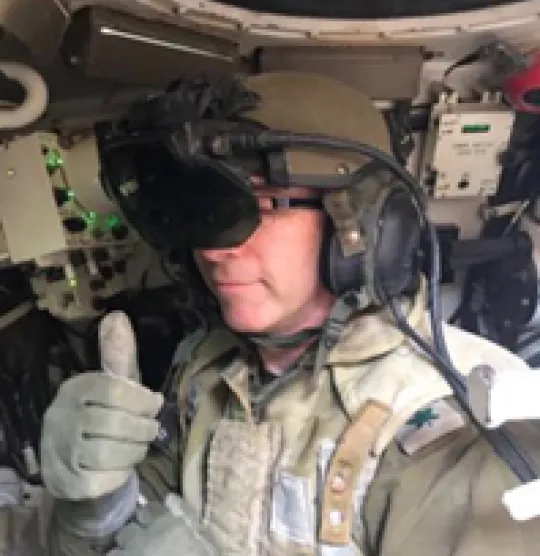
Even the helmet-mounted component reflects this approach. Rather than relying on entirely new equipment, the system can be adapted to existing helmets using a dedicated interface, aiming to simplify deployment and reduce the logistical burden for customers.
Lessons from Recent Combat Operations
Recent operational experience has reinforced the growing importance of close- and mid-range situational awareness for armored forces operating in complex environments.
Lessons learned from the IDF's " Swords of Iron" war highlighted the need for commanders to maintain continuous awareness while fighting with closed hatches, particularly in dense urban areas where threats can emerge from multiple directions.
Enhanced situational awareness contributes to:
- Greater confidence for commanders operating in urban environments while remaining protected inside the vehicle.
- Improved prevention of incidents involving friendly forces operating close to armored vehicles.
- Better understanding of nearby and mid-range threats in dynamic combat environments.
These operational requirements continue to shape the demand for systems that provide crews with immediate access to their surroundings without compromising protection.
A System Shaped by the Field
As interest in enhanced situational awareness continues to grow, systems such as IronVision are moving from a niche capability to an operational necessity. The ability to operate sealed, maintain continuous awareness, and reduce cognitive load addresses challenges that are becoming central to modern armored warfare.
For those working on the program, the impact is both technical and immediate. “You see how it performs in real scenarios,” Adiel says. “And you understand that what you’re building is not theoretical, it’s something crews rely on.”