

Listening for the Next Threat
Drones, loitering munitions and UAVs are reshaping the battlefield, and acoustic detection is becoming an important layer in the race to identify danger early enough to respond.
There are moments on the battlefield when the first sign of danger is not a radar track or a visual image but a sound: a shot cracking through the air, a mortar round leaving its tube, or a low-flying drone moving between buildings and roads.
This is the operating space of SOLOCATE™, an Elbit Systems ISTAR & EW business line whose name combines two ideas: the acoustic signature of a threat and the ability to locate it. The line includes two main products: FireTrap, designed to detect small arms fire, sniper fire, and artillery; and Skytrap, built to detect drones, FPV threats, and unmanned aerial systems, including attack UAVs and loitering munitions.
According to a Business Development Director in the SOLOCATE™ line of business, the logic is simple in principle but complex in execution, because every threat has its own acoustic signature. A machine gun, a sniper rifle, a mortar shell, or a small UAV all produce different sound patterns, and those patterns can be identified, filtered, and turned into actionable information.
“Every threat has a certain acoustic signature,” the director explains. “With small arms fire, for example, there is an initial sound when the bullet starts moving, and in many cases there is also a shockwave created when the bullet breaks the speed of sound. By analyzing those acoustic events, the system can help determine where the fire came from and support the fighting force in deciding how to respond.”
Low Altitude Changes the Equation
The rise of drones and loitering munitions has made acoustic detection more relevant. Some threats fly low, use small engines, and move through complex terrain, where traditional sensors may face limitations. Iranian Shahed-type UAVs, for example, can use different engine types, from small gasoline engines to electric propulsion systems, each with its own acoustic profile.
SOLOCATE™ is not meant to replace radar, electro-optics, SIGINT, or other detection layers. Its value lies in complementing them, especially against threats that are low, small, or difficult to classify early enough. The systems can operate with their own command-and-control interface, but they are also designed to integrate with broader C2 environments and connect to soft-kill or hard-kill effectors.
That integration matters because detection by itself is not enough. Once a system identifies and locates a threat, the force still needs a response chain. FPV drones, for example, often create tactical danger for maneuvering units, artillery, logistics, and forward positions. Larger UAVs or loitering munitions can become strategic weapons, capable of carrying heavier warheads over long distances and targeting infrastructure, bases, or energy sites.
“The drone threat and the UAV threat are not the same problem,” the director says. “Small drones are usually a tactical threat. Larger UAVs and loitering munitions can create strategic damage. They require different operational thinking, different warning timelines, and different response chains.”
From Fixed Sites to Moving Forces
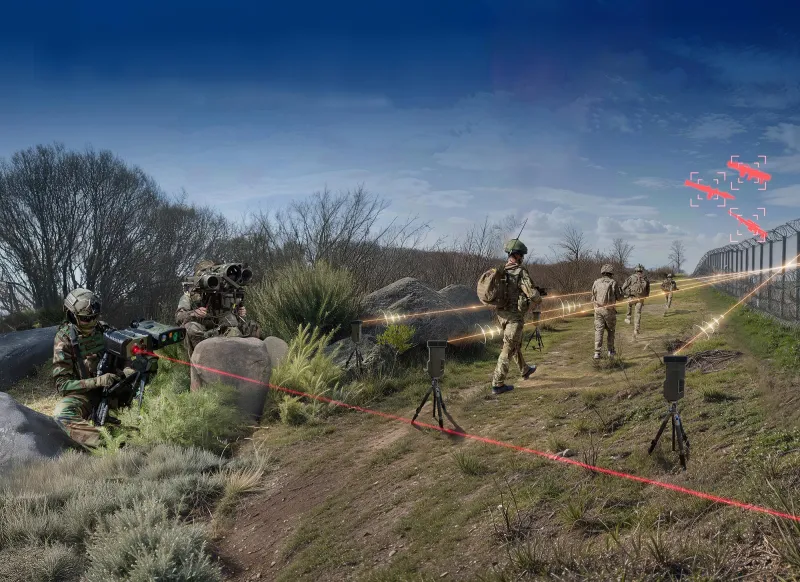
Today, acoustic systems are used to support the protection of bases, border areas, vehicles, and operational zones. In fire-detection missions, the system can identify small arms fire at ranges of up to 1,500 meters, depending on conditions and threat type. For Shahed-type UAVs, Skytrap can identify targets at distances of up to 10 kilometers from the sensor, giving operators more time to activate an intercept or another response.
The next challenge is mobility. Many acoustic systems are currently deployed in fixed or semi-fixed positions, where sensor placement can be optimized. But maneuvering forces need warning while they move through areas where fire, drones, and loitering threats may appear suddenly and from unexpected directions.
Elbit Systems is therefore working toward acoustic detection systems that can move with the force. The sensors are already compact enough for tactical use, with backpack-carried configurations weighing slightly more than 5 kilograms, including batteries. They can remain deployed in the field for extended durations, operate automatically, and send relevant output to a ruggedized tablet.
The Algorithm Behind the Microphone
The battlefield is noisy. Engines, wind, vehicles, generators, gunfire, urban echoes, and background activity all create acoustic clutter. The challenge is not merely to hear something but to know what matters. Elbit Systems’ technology, under development since 2015, uses advanced algorithms with AI-based components to identify relevant signatures, filter out noise, and classify acoustic anomalies.
“In the end, anyone can place microphones in the field,” the director says. “That alone does not create a capability. The difference is the algorithm, the experience behind it, and the ability to understand which acoustic anomalies are operationally relevant.”
This is especially important in complex terrain such as urban environments, Rugged and hilly terrain or forests where sound reflects between buildings or objects and can confuse simpler detection methods. Acoustic sensors are also passive: they do not transmit energy and therefore do not reveal themselves in the same way that active sensors do.
A Race to Identify Earlier
The demand for these capabilities is no longer limited to one theater. The war in Ukraine accelerated global awareness of drones, loitering munitions, and FPV systems, but similar threat patterns are now appearing in other regions, from Asia to contested border areas. The director says global customers increasingly understand that these threats will continue to multiply, become cheaper, and grow harder to detect.
For defense forces, the question is no longer only how to intercept a threat once it appears. It is how to build enough sensing layers to find it early, classify it correctly, and connect detection to response.
In that architecture, acoustic detection has a distinct role. It listens where other sensors may struggle, supports fixed defense today, and is moving toward the maneuvering battlefield of tomorrow.
