

The New Deterrence
Power is no longer measured only in platforms but also in the ability to see, understand, and shape reality before a conflict even begins.
For most of modern history, deterrence was something you could point to. It had weight, scale, and presence: fleets anchored in harbors, armored divisions lined across borders, squadrons ready on runways. The assumption was simple and deeply intuitive: the more force you could deploy, the less likely your adversary would be to challenge you.
That logic has not disappeared, but it is no longer sufficient. A quieter and more complex form of deterrence is taking shape, one that relies less on the visible accumulation of power and more on the invisible architecture of information.
From Platforms to Perception
The shift begins with a basic reality of contemporary conflict. The battlefield, in its broadest sense, is saturated with data. Satellites, sensors, communications networks, and unmanned systems all generate a continuous stream of signals. The question is no longer who has access to information but who can turn that information into understanding quickly enough to matter.
This is where deterrence begins to change its meaning. When a military demonstrates that it can see events as they unfold, interpret them in real time, and act with precision, it alters the calculations on the other side. The risk is no longer just retaliation. It is exposure, miscalculation, and a growing sense that any move will be anticipated before it is completed.
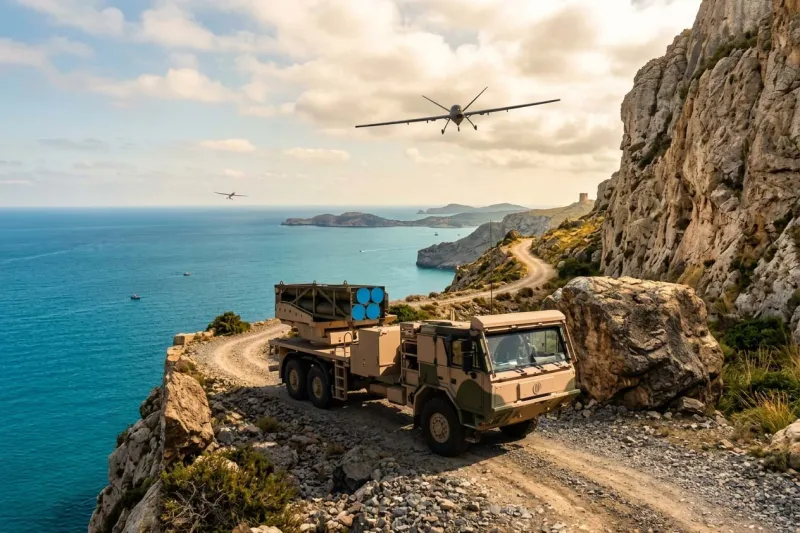
Systems such as Elbit’s Hermes 900 UAV illustrate how this shift plays out in practice. Designed to remain airborne for extended periods while carrying multiple sensor payloads, it creates something that older concepts of surveillance struggled to achieve: continuity. Not a snapshot, not a moment of intelligence, but a persistent presence that quietly removes the possibility of operating unseen. Over time, that persistence reshapes behavior. Movement becomes more cautious, timing more constrained, and initiative harder to maintain.
Deterrence at the Tactical Edge
What once required large, centralized intelligence structures is now moving closer to the tactical edge. Smaller units are increasingly equipped with systems such as the Skylark 3, which provide real-time intelligence in environments that were once defined by uncertainty. The importance is not only technological but conceptual.
When situational awareness becomes immediate and widely distributed, the tempo of decision-making accelerates. Deterrence is no longer something imposed from above. It becomes embedded in the daily rhythm of operations, shaping interactions long before they escalate.
At the same time, visibility itself is being redefined. In earlier eras, concealment was the ultimate advantage, and exposure was something to be avoided at all costs. Today, controlled visibility has become a strategic tool in its own right. Systems such as Iron Vision, which help armored crews to see through the vehicle in real time, offer a glimpse into this shift.
The deeper effect lies in how that awareness translates into confidence. A force that operates with clarity tends to act faster, with fewer errors and less hesitation, and that confidence, when perceived by an adversary, feeds directly into deterrence.
A Strategic Signal
Even in areas that appear more traditional, the underlying logic has evolved. Rocket systems such as the PULS are no longer defined solely by their range or payload but also by the ecosystem in which they operate.
Precision targeting, rapid integration with intelligence sources, and the ability to demonstrate those capabilities without necessarily employing them all contribute to a different kind of signal. Accuracy becomes more than a technical feature. It becomes a form of communication, conveying not just the ability to strike but the likelihood that any strike will be measured, deliberate, and difficult to evade.
What ties these developments together is not a single technology but a broader shift in how power is exercised. Deterrence increasingly operates in the space between action and perception, where information is collected, interpreted, and selectively revealed. It is shaped as much by what is known as by what is shown and by the careful calibration of both.
Cognition begins to take on the characteristics of a domain in its own right. The ability to influence how an adversary understands a situation, how quickly they can respond, and how much uncertainty they must contend with becomes a decisive factor. This is not the language of overwhelming force but of shaping choices, narrowing options, and making escalation feel less viable with each passing moment.
None of this renders traditional capabilities obsolete. Physical force remains an important foundation and, in many cases, a key guarantor of deterrence. But it is increasingly complemented, and in some scenarios preceded, by a layer of informational dominance that operates continuously, often quietly, and sometimes invisibly.
Important Notice: Certain blog articles may contain forward-looking statements and are not intended to provide business, financial, or investment information. Please review our full disclaimer here.