

Owning the Spectrum
Integrated Electronic Warfare battalions are designed to connect sensors, intelligence systems, jamming capabilities and command posts into a single operational framework.
The electromagnetic spectrum has become one of the most crowded parts of the battlefield. Communications networks, radar systems, sensors, military emitters and civilian transmissions all operate at once, often across overlapping frequencies and over large geographic areas.
For Electronic Warfare units, the problem is no longer simple to detect a transmission. A signal must be identified, classified, located and placed in context. Operators need to understand whether it belongs to a radar, a communications network or another electronic system, and how it relates to activity elsewhere in the area.
For more than 25 years, SIGINT and EW capabilities have been developed around this challenge. At battalion level, the focus is not on any single sensor or platform, but on integrating Communications Intelligence, Electronic Intelligence, jamming, electronic countermeasures and command-and-control systems into one operational structure.
How Does it Work?
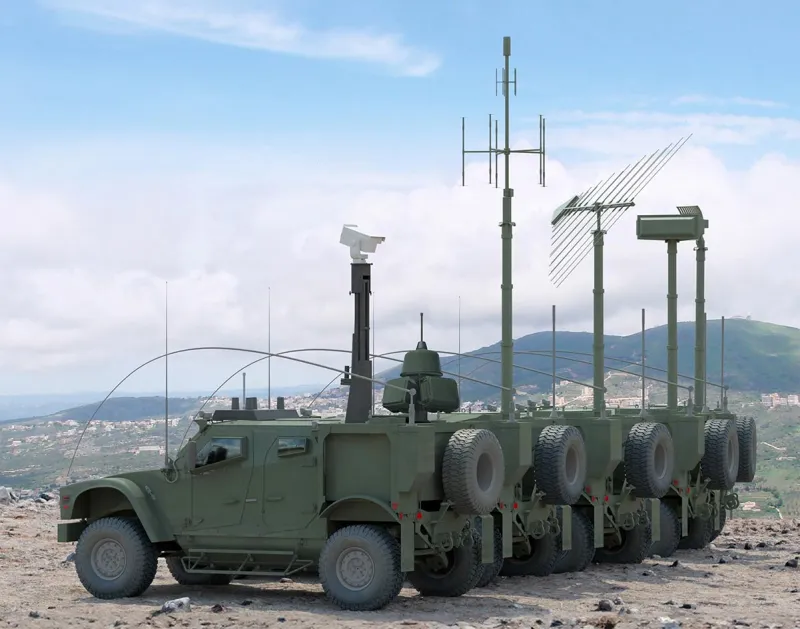
A typical EW battalion may include dozens of systems deployed across fixed sites, mobile platforms and command posts. Each collects a different part of the picture. The command system at the center of the battalion brings those inputs together, correlating information from multiple sources and presenting operators with an updated view of activity across the spectrum.
This process is used to build the Electronic Order of Battle, a dynamic picture of the emitters and electronic networks operating in the area of interest. In practice, EW systems spend much of their time monitoring rather than disrupting. They follow radar emissions, communications traffic and changes in transmission patterns, gradually building a picture that can support later decisions.
That task has become more difficult as the spectrum has grown more congested. Communications may be encrypted or move rapidly between frequencies. Radars may be transmitted only for short periods. Some emitters appear intermittently, while others are deliberately operated in ways intended to make identification or geolocation more difficult. Civilian communications add another layer of background activity.
A detection on its own therefore provides limited value. Information from several sensors may need to be compared before an emitter can be classified or linked to a particular system. A radar signal, for example, may form part of a wider operational network. A communications transmission may indicate the presence of a unit, a command post or another node within a larger structure.
The purpose of an integrated battalion is to connect those observations. Information gathered by one element can support the work of another, whether through improved identification, geolocation, targeting or electronic action. This also reduces the need to move information manually between separate systems and operators.
The same principle applies to the way EW assets are deployed. Fixed sites and mobile platforms serve different purposes, but they are more effective when they contribute to the same operating picture.
Fixed systems provide continuous monitoring across broad areas. Their persistent presence allows operators to follow changes in electronic activity over time and maintain surveillance of sectors that remain operationally important. Mobile platforms can move with deployed forces, close gaps in coverage and respond to changes in the mission.
Connecting both through a resilient communications network allows data collected in different locations to be processed together. Fixed installations, mobile sensors, jamming systems and command posts feed information into a central processing environment, where it can be aggregated, correlated and analyzed.
A New Apparatus
This centralized approach is particularly important when the battalion is handling large volumes of data. Analytics and large-scale processing can help identify recurring patterns, compare emitter behavior, improve target recognition and accelerate geolocation. Each sensor contributes its own information but also benefits from the observations collected by the rest of the force.
Technical architecture is only one part of the capability. EW operations depend heavily on the people using the systems. Operators must interpret incomplete information, distinguish between similar emitters and coordinate intelligence collection with other operational activity.
Training centers and simulation systems are therefore included in many battalion-level programs. They allow crews to practice detection, classification, analysis and response in realistic electromagnetic conditions before deployment. Simulated scenarios can reproduce dense signal environments, intermittent transmissions and multiple systems operating at the same time.
Integrated EW battalions are generally developed as complete operational programs rather than supplied as collections of standalone products. A deployment may involve thousands of components, communications infrastructure, integration, testing, validation and training.
Military customers also tend to begin with an operational problem rather than a fully defined technical specification. The work therefore includes translating that requirement into a system architecture, adapting it to existing forces and developing the procedures needed to operate it.
The result depends less on any individual sensor than on the way the battalion’s different elements are connected. The central requirement is to take signals collected across the electromagnetic environment and turn them into a coherent picture that commanders and operators can use.
Important Notice: Certain blog articles may contain forward-looking statements and are not intended to provide business, financial, or investment information. Please review our full disclaimer here.