The Robot Is Getting Closer to the Mission
After joining Elbit Systems, Bluewhite is bringing civilian autonomy, startup agility, and operational robotics into one connected ground-and-air ecosystem.
Following Elbit Systems’ Fuse acquisition of Bluewhite, an autonomous vehicles and AI company, Bluewhite is being integrated into a fast-moving environment designed to combine the speed of a startup with the scale, market access, and operational experience of a global defense technology company. The goal of the merger is clear: to build a home for physical AI, autonomy, and robotics, connecting ground and air capabilities under one roof.
“Our expertise is advanced AI for ground robotics,” says Ben Alfi, CEO and founder of Bluewhite. “The reason we were acquired by Elbit was to take our experience from more than 100,000 hours of autonomy in offroad applications and apply it to military autonomy at an operational level.”
Almost a Decade of Expertise
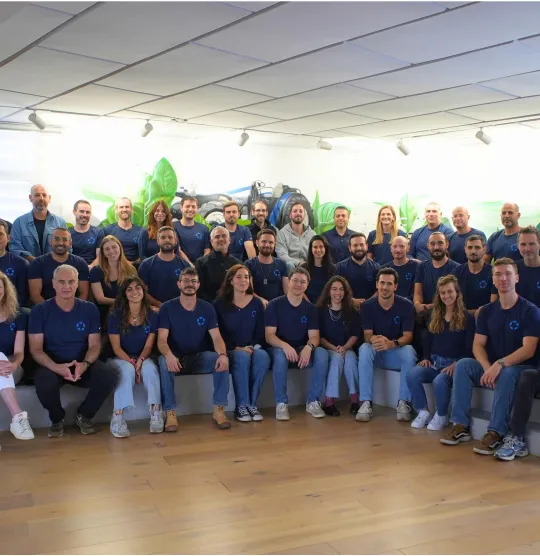
Bluewhite was founded in 2017 with the aim of bringing autonomy to the world on a scale. Since 2020, the company has focused heavily on off-road autonomy, cloud-based command-and-control, data systems, and AI-driven robotic capabilities. Based in Tel Aviv, the company is deeply engineering-led, with around 85% of its employees working as engineers across mechanics, electronics, AI, and software. Women make up about a quarter of the company, including in core engineering teams.
In recent years, the need for autonomous capabilities has grown in Israel, Europe, the United States, and other markets. Militaries are looking for ways to operate in environments where the distance between the front line, border areas, and the logistics space has become compressed and exposed. In such conditions, any mission that can be performed remotely or autonomously becomes more than a technological advantage.
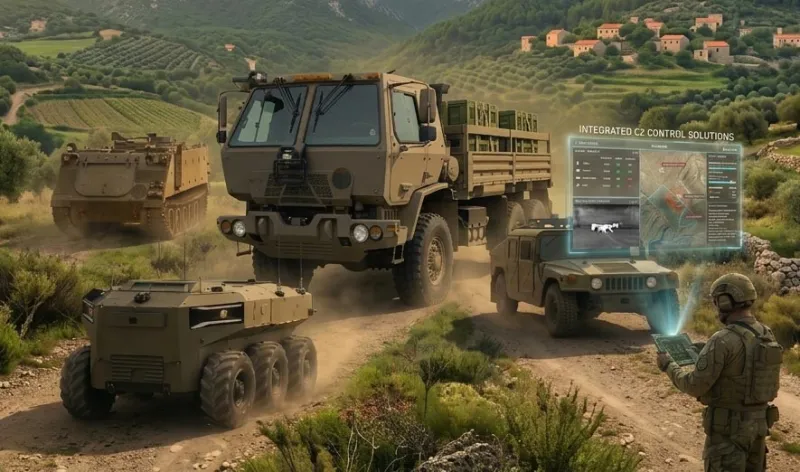
According to Alfi, the vision is to provide a complete robotics response for the modern maneuvering force, covering drones, ground vehicles, remotely operated systems, autonomous upgrades for existing fleets, and the command-and-control layer that connects them all.
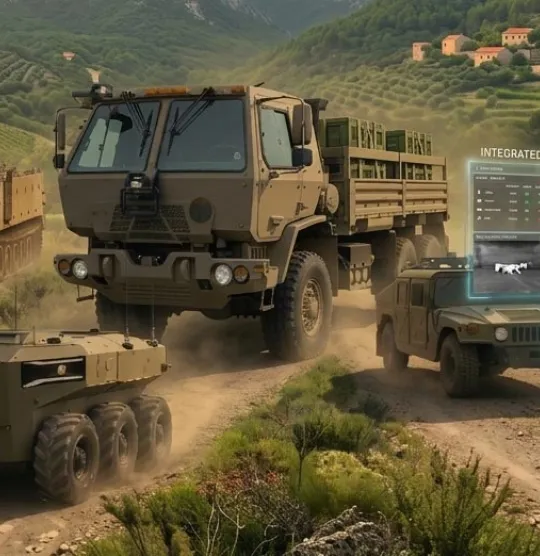
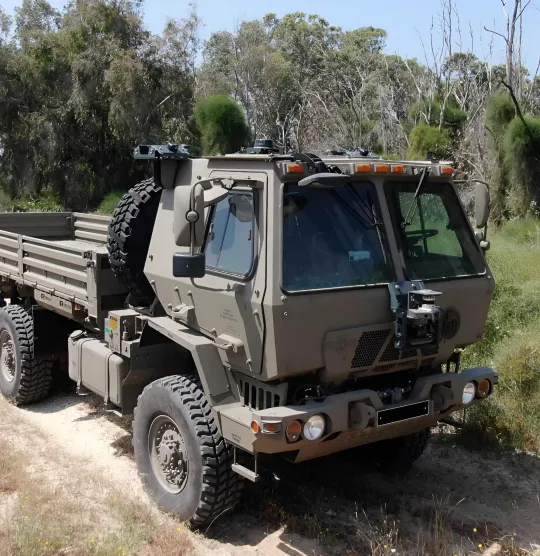
The main mission areas include border protection, support for maneuvering forces, logistics convoys, and Manned-Unmanned Teaming, in which soldiers and robotic systems operate together as one force. Some of these systems may be purpose-built robots called UGV. Others may be existing customer vehicles upgraded with end-to-end autonomy kit allowing a fully autonomous maneuvering, tele-operation of the platform or manned operation with driver assist capabilities.
“We see ourselves as an enabler,” Alfi says. “We can connect with the different payloads and capabilities across Elbit’s divisions and bring interoperability to the forces using them.”
Stronger Through Teaming
The approach is not limited to building new systems from scratch. An important part of the vision lies in upgrading existing fleets with ADAS (Advanced Driver Assistance Systems), EVPS (GPS-denied Navigation System), full autonomy kit, advanced communications, and data-driven mission capabilities. For military customers, that can mean turning a logistics vehicle, a border protection platform, or another operational asset into a more flexible and survivable system.
Looking ahead, Bluewhite is engaged in advanced discussions with customers and OEMs around the world.
A Shift from Civilian to Military
Autonomous vehicles began as a civilian revolution, driven by the automotive industry, better sensors, cheaper hardware, and advances in AI. Defense organizations are now taking those same technological building blocks and adapting them to a different reality, where off-road mobility, uncertainty, navigation and communications challenges, and operational pressure are all part of the mission. “The civilian world was the driver,” Alfi says. “Recent autonomous technology advancement met a military need, and now armies and security organizations are adopting it.”
In Alfi’s view, the central shift is not only about saving manpower, though that remains a major driver. It is also about saving lives. Robotic systems can be sent into dangerous environments, support forces under pressure, and allow humans to remain farther from the line of contact while still achieving operational effects.
“If three years ago having a robot was rare, today almost every maneuvering force operates alongside ground and aerial robotic systems,” he says. In practical terms, this means enabling forces to launch reconnaissance and strike drones, protect themselves against hostile drones, operate ground robots, and manage all these capabilities through an orchestrated command-and-control environment.
The long-term direction is even broader. Alfi believes the world is moving toward robotic factories for drones and ground systems, as well as the large-scale deployment of autonomous tools at costs that make them available not only as rare, specialized assets but as a routine part of the force.
“I like creating things with meaningful impact,” he says. “The ability to move people back from the line of contact while still delivering strong operational capabilities and helping prevent harm to our people is what drives me.”
The result is a convergence of AI, robotics, and defense technology. But the deeper story is about people: how to protect them, reduce risk, and give commanders new options in an environment that is changing faster than traditional systems can adapt.
FAQ
How are autonomous vehicles used in military operations?
Autonomous vehicles can support logistics, border protection, reconnaissance, and maneuvering forces while reducing risk to personnel and increasing operational flexibility.
What is Manned-Unmanned Teaming (MUM-T)?
Manned-Unmanned Teaming is an operational concept in which soldiers work alongside autonomous ground and aerial systems that support missions through sensing, mobility, protection, and other capabilities.
Can existing military vehicles be upgraded with autonomous capabilities?
Yes. Existing fleets can be enhanced with autonomy kits, driver assistance systems, advanced communications, and GPS-denied navigation capabilities to improve operational effectiveness.