

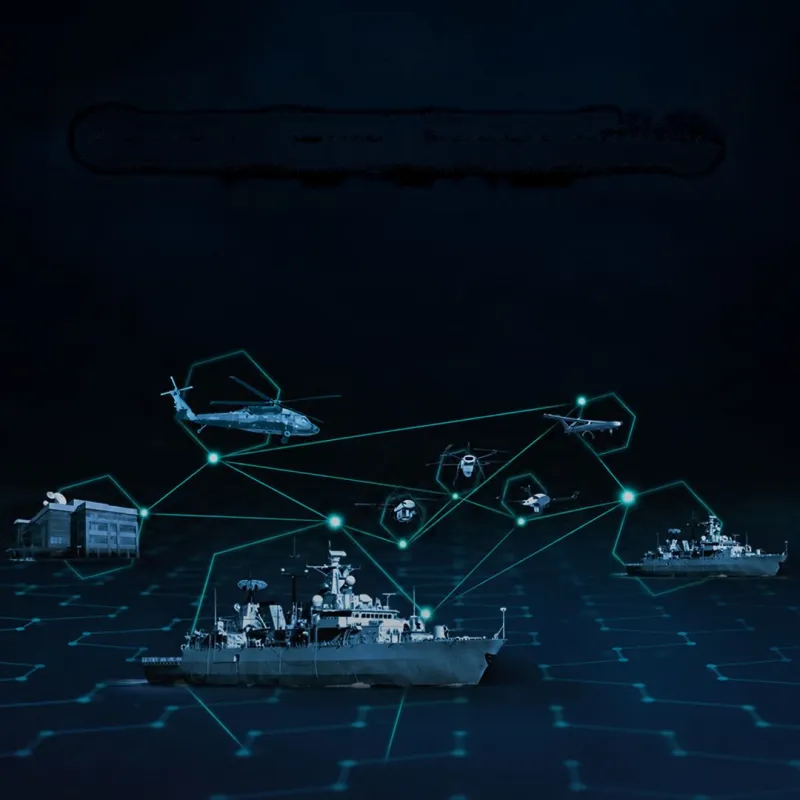
At Sea, Every Link Matters
A naval vessel may lose one communications path, switch to another, and still need to keep information moving between sea, air, and land. That is why interoperability and multi domain connectivity have become as important as range or bandwidth.
Key Takeaways
- One architecture can combine HF, VHF, UHF, SATCOM and LOS communications.
- Naval communications must coexist with radar, EW, navigation and weapons systems.
- EMI and spectrum management is a critical part of maritime system integration.
- The same network can connect ships, shore forces and unmanned aircraft.
- A single integrator can reduce the complexity of working with multiple OEMs.
A modern naval vessel is expected to remain connected across several very different operational environments. It may need to communicate with another ship only a few miles away, exchange information with a command center hundreds or thousands of kilometers from its position, connect with units operating on land, and receive live video from an unmanned aircraft launched from its own deck.
Each of those connections may rely on a different technology, frequency range, or data rate, but from the crew's perspective, they all need to function as part of the same operational environment.
“We understood that the real requirement is to provide a complete communications solution, covering ship-to-ship communications as well as the connection between the ship and the shore,” says Idan, Naval Communications Product Manager at Elbit Systems' C4I and Cyber Division. “That means combining strong internal communications with VHF and UHF radios, long-range HF and SATCOM, high-data-rate line-of-sight links, and communications with aircraft and unmanned systems operating from the deck.”
The challenge, therefore, is not simply to install another radio on a ship, but to create an architecture in which several communications layers can operate together, alongside the many other systems already competing for space and spectrum aboard the vessel.
The Sea Is a Different Communications Environment
Many communications technologies used at sea have equivalents on land, but the engineering priorities are not necessarily the same.
For a dismounted soldier, the radio is part of the load carried on the body, so weight and battery life become major considerations. A naval platform faces a different set of constraints. Weight is generally less critical, but the vessel must be able to operate independently, maintain multiple communications options, and continue functioning even when a particular link to shore is unavailable.
“The operational concept at sea is different from what we see on land,” Idan explains. “A ship must know how to operate independently before it operates as part of a wider force. At the same time, most of the traffic around it is civilian, so military communications have to coexist with civilian safety and navigation systems without interfering with one another.”
This creates an unusual mix. A naval vessel may simultaneously operate secure military communications, civilian maritime safety systems, navigation equipment, tactical data links, and mission systems, all within a relatively confined platform. The communications architecture has to account for all of them.
Different Links for Different Missions
There is no single communications technology that can provide every capability required by a naval force. VHF and UHF communications can support tactical connectivity with nearby ships and forces. HF provides long-range communications and can remain useful when other infrastructure is unavailable, although it is better suited to relatively low-bandwidth requirements. SATCOM provides another form of beyond-line-of-sight connectivity but introduces dependence on satellite availability.
Closer to shore, line-of-sight communications can provide higher data rates between a vessel and coastal infrastructure. At the same time, a ship may need dedicated communications with unmanned systems or aircraft operating away from the platform.
“Every UAV or USV is transmitting information back, whether that is video to the operator, data to the ship, or information that ultimately needs to reach a commander on shore,” says Idan. “All of that depends on communications.”
For naval forces, these are not separate communications problems. They are different layers of the same operational network.
Elbit Systems' maritime communications approach is designed to bring those layers together, including HF, VHF, UHF, SATCOM, and LOS communications, while supporting NATO-standard environments such as Link 11 and Link 22.
Managing a Crowded Electromagnetic Environment
A warship is also one of the most demanding electromagnetic environments in which communications equipment has to operate. The same platform may include radar, navigation systems, electronic warfare capabilities, missiles, and several communications systems, all transmitting or receiving electromagnetic energy within a comparatively small physical space.
“One of the main issues in maritime communications is EMI,” Idan says. “You have communications equipment operating next to radar, navigation systems, missiles, and other combat systems, and everything has to work correctly while living alongside everything else.”
This is where system integration becomes particularly important. A radio may perform perfectly when tested independently, but the real engineering challenge begins once it is installed alongside several other RF systems. Frequencies must be managed, antennas have to coexist, and the platform has to operate as a complete system rather than as a collection of individual products.
The problem can become even more complicated when different parts of the communications environment come from several manufacturers. One company may provide VHF equipment, another HF, another SATCOM, and another the tactical data-link components, leaving the customer or platform integrator responsible for making all of them work together.
“In the end, our advantage is that we act as the integrator and take responsibility for communications across the ship from end to end,” Idan says. “The customer does not have to manage another OEM for every frequency domain and then deal with the possibility that those systems interfere with one another.”
Connecting the Ship to the Wider Force
An integrated maritime communications architecture can also create continuity between the naval platform and forces operating in other domains.
For customers that already use Elbit Systems communications on land, a naval deployment does not necessarily need to begin with an entirely separate communications ecosystem. Existing systems can become part of the connection between ships, coastal headquarters, and ground units.
“If a customer already operates our systems in the land domain, we can come to the naval platform with technology that already has interoperability to those systems,” Idan says. “If the customer has E-LynX on the ground, for example, that creates an opportunity to support communications between the ship and the shore, or between the vessel and ground units, using an ecosystem they already deployed.”
That becomes increasingly significant as naval operations become more multi-domain. A vessel may receive information from a UAV, pass it to another ship, and share it with forces ashore. From an operational perspective, the value lies in allowing that information to move across the force without creating unnecessary barriers between sea, land, and air.
Elbit Systems can also combine its maritime communications capabilities with solutions developed elsewhere in the company, including ISTAR, electronic warfare, cyber, and unmanned systems, depending on the requirements of the customer and the platform.
From Individual Radios to a Communications Architecture
Elbit Systems has already introduced its naval E-LynX solution and HF capabilities to the market and presented them at international exhibitions, while continuing to develop the portfolio in response to emerging customer requirements.
Idan says interest has increased as more customers recognize the value of approaching naval communications as an integrated system rather than as a series of separate procurements.
The reason is straightforward. Naval platforms are carrying more sensors, unmanned systems are generating increasing amounts of data, and ships are expected to communicate with a wider range of forces across multiple domains.
In that environment, the performance of an individual radio remains important, but it is only part of the equation. What increasingly matters is whether all of the communications layers aboard the ship can work together without creating new integration problems for the customer.
Specs
- Multi-Band Communications: Integrated support for HF, VHF, UHF, SATCOM, and high-data-rate LOS links.
- NATO Interoperability: Support for naval environments using Link 11 and Link 22.
- Naval E-LynX Integration: Maritime connectivity designed to work alongside existing E-LynX deployments on land.
- UAV Connectivity: Communications links for transmitting video, coordinates and mission data from unmanned aircraft.
- Platform-Level Integration: Communications designed to operate alongside radar, navigation, EW and weapons systems while addressing EMI considerations.
FAQ
What Is Elbit Systems’ Integrated Maritime Communications Solution?
Elbit Systems’ maritime communications solution brings together naval HF, VHF, UHF, SATCOM and high-data-rate LOS capabilities within a single integrated architecture. It is designed to support ship-to-ship, ship-to-shore and unmanned-platform communications while operating alongside radar, navigation, EW and other onboard systems.
Why do naval vessels need several different communications systems?
Different missions require different combinations of range, bandwidth and availability. HF, VHF, UHF, SATCOM and LOS links therefore complement one another rather than serving as direct substitutes.
How do unmanned aircraft fit into naval communications?
UAVs can transmit live video, coordinates and other mission information back to the vessel, an operator or a command center ashore, making reliable communications a fundamental part of their operational value.
How can naval forces connect with units operating on land?
Customers already using systems such as E-LynX in the ground domain can integrate compatible maritime communications, helping connect ships with coastal headquarters and ground forces.
Important Notice: Certain blog articles may contain forward-looking statements and are not intended to provide business, financial, or investment information. Please review our full disclaimer here.


