From Static Bases to Mobile Networks
Elbit Systems Sweden’s Tactical High Mobility System (THMS) project reflects a broader shift in land operations: communications, sensors, and command capabilities must now move as quickly as the forces they support.
Key Takeaways:
- THMS enables military units to deploy communications, sensors, and other mission systems rapidly without relying on fixed infrastructure.
- The system supports the Swedish Armed Forces’ broader transition from analog systems to fully digital and networked operations.
- Its modular architecture allows it to carry different payloads, including communications equipment, ISTAR sensors and counter-UAS capabilities.
- THMS is being developed in both crewed and remotely operated configurations, with future development expected to move toward greater autonomy.
- The system is designed for Scandinavian conditions and supports growing European and NATO requirements. THMS will be manufactured in Sweden to secure the supply chain.
Military communications infrastructure was traditionally built around relatively stable assumptions: units operated from established bases, command posts remained in place for extended periods, and networks could be deployed accordingly. Those assumptions are becoming increasingly difficult to maintain.
“The war in Ukraine has reinforced the need for highly mobile and dispersed operations,” says Christian Tengelin, Director of Business Development at Elbit Systems Sweden.
“While mobility and dispersion have long been important military principles, today's battlefield demands that units establish connectivity, operate, and relocate much faster than before. Remaining in one position for too long can quickly lead to detection and targeting.”
This operational shift is at the center of the Tactical High Mobility System (THMS), being developed and produced by Elbit Systems Sweden for the Swedish Armed Forces.
A Swedish Breakthrough
Elbit Systems Sweden employs approximately 120 people and works across a broad range of capabilities, from cyber and communications to systems supporting dismounted soldiers. According to Tengelin, the THMS program has expanded considerably since the original contract was awarded, both in scope and value.
That development followed close collaboration with the customer, during which the system’s intended role became more clearly defined. What began as a replacement for an existing Swedish military capability evolved alongside a changing understanding of how dispersed forces are expected to operate.
For countries with large territories and long borders, the challenge is not only moving personnel and vehicles. Units spread across wide areas must remain connected to one another and to higher command while retaining the ability to deploy sensors, communications equipment, and other mission systems at short notice.
Versatile Payloads
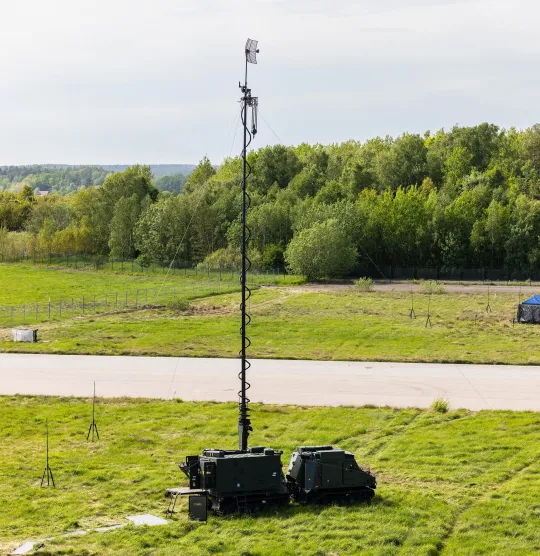
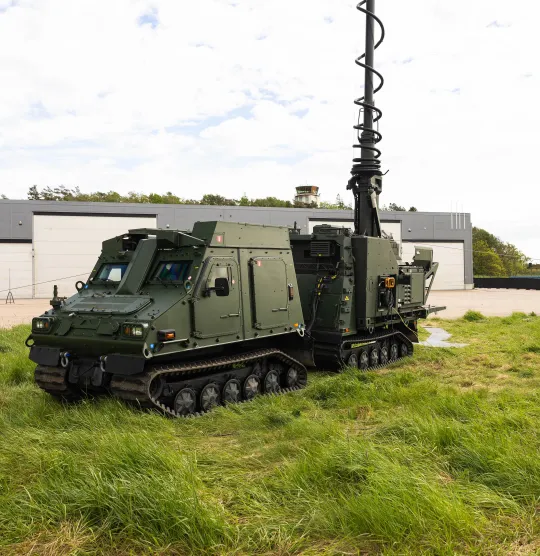
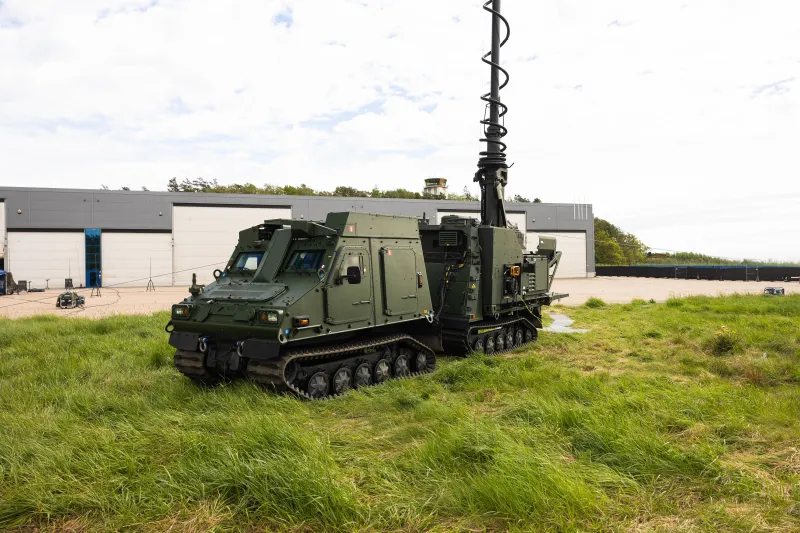
THMS is designed as a mobile platform that can carry different payloads according to the operational environment. These may include communications equipment, surveillance sensors, cameras, or systems intended to support counter-unmanned aircraft missions.
“The payload can change depending on the customer’s requirements and the conditions in which the system is operating,” says Sakarias Söderberg, THMS Project Manager at Elbit Systems Sweden. “The important point is that the unit can deploy independently and establish the required capability very quickly.”
The first unit is scheduled for delivery to the Swedish Armed Forces during the summer, with further contractual milestones expected to follow next year. The system forms part of a broader transition within the Swedish military from analog infrastructure to fully digital operations.
That transition is not limited to replacing one generation of equipment with another. A digital force must be able to move information between sensors, field units, and headquarters without relying on a permanent command structure at every location. A deployed unit may need to establish a communications node, connect remote forces, or position an intelligence and surveillance sensor, all while limiting the time spent in one place.
Two Different Configurations
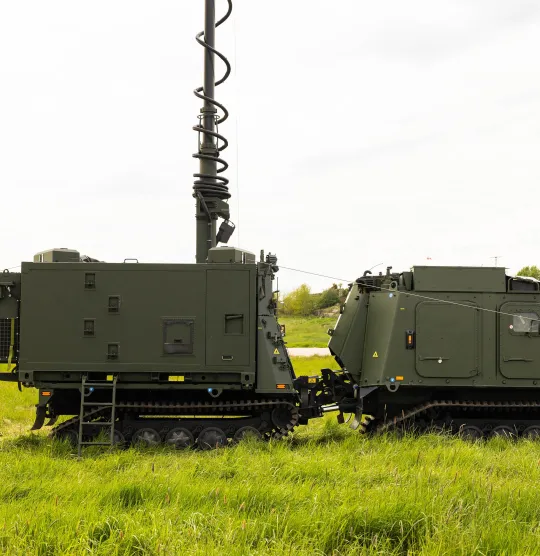
THMS is being developed in two principal configurations. One includes space for an operator inside the vehicle. The second, larger configuration is remotely operated and does not require personnel to remain inside the platform.
The distinction is increasingly important. Vehicles carrying communications equipment, sensors, or command systems can become priority targets. Removing the operator from the platform can reduce exposure while allowing the system to continue supporting forces from a separate location.
The longer-term challenge is balancing payload height, stability, and mobility within a single platform. Achieving operational capability often requires elevating heavy communications or sensor payloads to heights exceeding 20 meters, while maintaining stability in demanding conditions, including strong winds. This inevitably requires a robust and rigid mast structure, which adds significant weight and complexity. At the same time, the overall system must remain within strict weight limits to preserve platform flexibility, allowing deployment on a range of vehicles, from small tracked platforms to 4x4 flatbed vehicles. According to Söderberg, finding the right balance between mast performance, payload capacity, stability, and mobility is one of the key design challenges for future system development.
Now, as this balance has been achieved, the natural evolution of the concept is deployment on fully autonomous platforms, further increasing survivability while maintaining the ability to rapidly establish communications and sensor capabilities wherever they are needed.
DALO Industry Days
THMS will be presented outside Sweden for the first time at DALO Industry Days in Denmark in late August. Elbit Systems Sweden will demonstrate the system as part of the company’s C4I portfolio, alongside E-LynX radios and other communications capabilities.
The platform will also be shown in an ISTAR configuration equipped with a long-range camera, illustrating how the same mobile system can be adapted from a communications node into a surveillance asset. According to the company, the presentation reflects the Swedish customer’s interest in demonstrating the concept to other potential users.
The system will be manufactured in Sweden and adapted to the climatic and regulatory requirements of the European market. Equipment intended for Scandinavian operations must remain functional at temperatures as low as minus 40 degrees Celsius, conditions that many existing systems were not designed to withstand.
Local production is also becoming a central requirement for European and NATO customers. Governments are placing greater emphasis on secure supply chains, regional manufacturing capacity, and the ability to maintain military systems within Europe, particularly during extended periods of disruption.
For Elbit Systems Sweden, THMS brings those requirements together: local production, operation in extreme conditions, and a design intended for forces that can no longer assume they will remain in one location for long.
Specs
- System type: Mobile, modular platform for tactical communications, sensors, and mission systems
- Primary applications: C4I, tactical communications, ISTAR, and counter-UAS operations
- Configurations: Crewed and remotely operated variants
- Target payload capacity: More than four tons of mission equipment
- Communications role: Connects dispersed units to one another and to higher command
- Sensor integration: Supports cameras, surveillance sensors, and other mission-specific payloads
- Deployment: Designed for rapid setup, operation, and relocation in the field
- Operating environment: Adapted for Scandinavian conditions, including temperatures as low as −40°C
- Production: Manufactured in Sweden
- Development direction: transition toward fully autonomous operation
- Supply-chain model: Supports European and NATO requirements for local production and secure supply chains.
FAQ
What is a tactical mobile communications system?
A tactical mobile communications system provides military units with deployable connectivity, command-and-control capabilities and access to operational information while operating away from fixed infrastructure.
Why are mobile military systems becoming more important?
Modern forces need to deploy and relocate quickly. The growing use of drones, sensors and precision weapons has increased the risks associated with fixed command posts, communications nodes and other static positions.
How do mobile systems support dispersed military units?
They allow units operating across large areas to remain connected to one another and to higher command. They can also extend communications and sensor coverage into locations without permanent infrastructure.
What is the role of C4I in modern land operations?
C4I systems connect commanders, soldiers, communications networks and intelligence sources. Their purpose is to create a shared operational picture and help forces coordinate decisions and actions in real time.
How does digitization change military operations?
Digitization allows information from sensors, field units and command centers to move more quickly across the force. It also reduces dependence on analog processes and isolated systems.
What are the advantages of modular military platforms?
A modular platform can be adapted for different missions by changing its payload. The same system may support communications, surveillance, intelligence collection or counter-UAS operations.