

Submarine warfare: The deal bringing Elbit into the undersea world — and into a battle with Israel Aerospace Industries
After Israel Aerospace Industries sold an autonomous submarine to Germany, Elbit is also charging into the undersea world with the acquisition of a Canadian company. “Ukraine’s war against the Russian navy has changed the scene”, says Saar Koursh, head of Elbit’s naval systems sector. Are these the tools that will win the campaign in the Strait of Hormuz and Bab el-Mandeb?
by Hagay Amit | TheMarker
In the early 1980s, during the Cold War between the Soviet Union and the United States, the Canadian submarine company ISE carried out a particularly ambitious naval project. ISE, founded in 1974, was then a young company, yet it was chosen to develop and build an autonomous submarine, or, in industry parlance, an unmanned undersea vehicle (UUV), whose mission was to navigate beneath the North Pole to establish a sonar array to serve Canada and the United States.
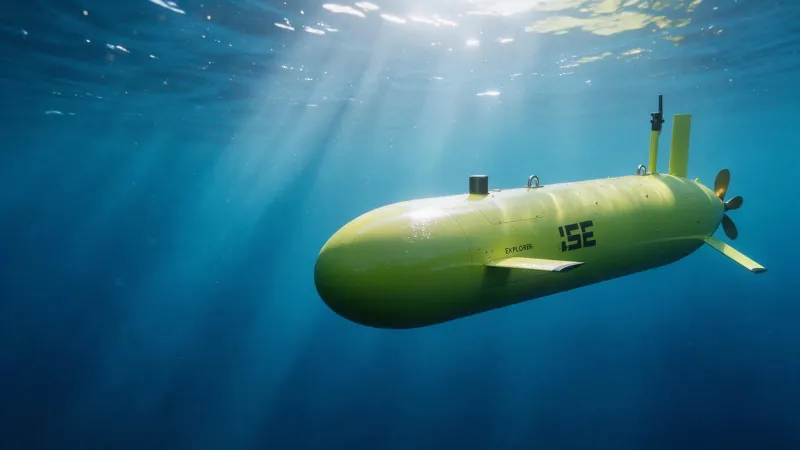
The reason for the project was the Americans’ realization that Soviet submarines were using the natural concealment provided by the Arctic Ocean to travel from the Pacific Ocean to the Atlantic. The device developed by ISE (short for International Submarine Engineering) was about 32 feet (about 10 meters) long and was called Theseus. To this day, it can be seen at ISE’s facilities in Canada, and descendants of that model are among the company’s products displayed on its website, alongside other vehicles such as ISE’s most advanced vehicle, a product called Explorer, which can reach a depth of 6,000 meters.
Since last October, these vehicles have been part of the portfolio of the Israeli company Elbit, which has acquired ISE. On the British financial analysis site Krugman Insights, the deal was estimated at $40 million, but Elbit declined to comment on the price it paid, given that it is below the bar for a material transaction whose value the company would be required to report to the stock exchange. However, even if this is not a mega-deal for Elbit, whose sales totaled $8 billion in 2025, it brings the company into the undersea world for the first time.
Besides autonomous submarines, ISE also manufactures autonomous undersea vehicles, and Elbit aims to turn ISE into a platform to which it can add other systems that it manufactures, to be integrated into ISE’s autonomous vessels. This week, protests could already be heard in the Canadian media over the country giving up one of its vital assets.
The significance of ISE’s acquisition is that Elbit will be competing head-to-head with Israel Aerospace Industries, which manufactures the BlueWhale, an unmanned submarine that the company has supplied to the German Navy. This competition could be fierce because ISE was involved in developing the BlueWhale and previously owned rights to the product developed at IAI.
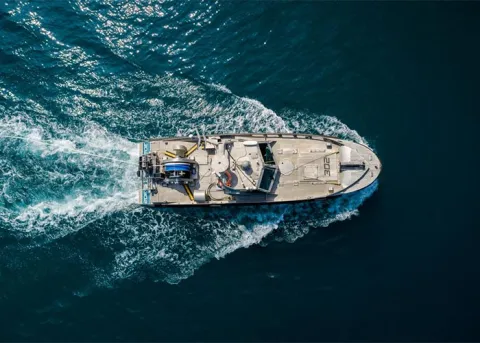
Although Elbit has been manufacturing the Seagull, an unmanned craft that can serve as a patrol vessel or torpedo boat, for several years, it does not make undersea vehicles. The significance of the acquisition is that Elbit will now compete head-to-head with Israel Aerospace Industries, which manufactures BlueWhale, or by its Hebrew name, Kesaron, an unmanned submarine that the company has already delivered to the German Navy. This competition may be particularly fierce, given that ISE, as we reveal here for the first time, was involved in developing the BlueWhale and previously held rights to the product that was developed in IAI’s Elta Division.
“The nightmare scenario: the entire global communications infrastructure goes down”
The key figure at ISE for most of its history was the company’s founder, James McFarlane, a Canadian engineer and former Royal Canadian Navy officer who passed away four years ago. Despite its innovation, the company was not commercially successful, selling a total of about 250 vessels to 20 countries over the course of its existence. Over the years, its operations continued to shrink. Today, it employs only a few dozen people, and its managers have been looking for a buyer for the company. At the same time, the shifting global balance of power has prompted Elbit to seek an acquisition that would enable it to establish a presence in the undersea domain. An example of the importance of the field was seen last week in the Black Sea, when three unmanned vessels belonging to the Ukrainian military struck a container ship operating for ZIM in the Black Sea, which sank within hours.
“In Canada, they understand that as a result of this deal we will expand the company’s operations and create jobs in Canada,” says Saar Koursh, Vice President of Elbit’s Intelligence and EW (electronic warfare) Division and head of the company’s naval systems sector. When asked whether there had been any problem in Canada with the acquirer being an Israeli company, he answers in the negative. “Seven years ago, we acquired GTI in Canada (which manufactures sonars for undersea communications, H.A.), a company with 50 employees that will end 2026 with 350 employees, 90% of whose activity is devoted to exports. Elbit brought resources – a financial investment and a large marketing infrastructure – and the intellectual property and technology remained Canadian. We will do the same at ISE. We will invest a great deal and triple the workforce,” says Koursch. workforce”, says Koursch.
“Around the world, navies receive enormous budgets. Elbit realized this about six years ago and decided that it wanted to grow in the naval sector. “You can’t neglect this part of the business, and today we make anything that can be installed on a vessel”
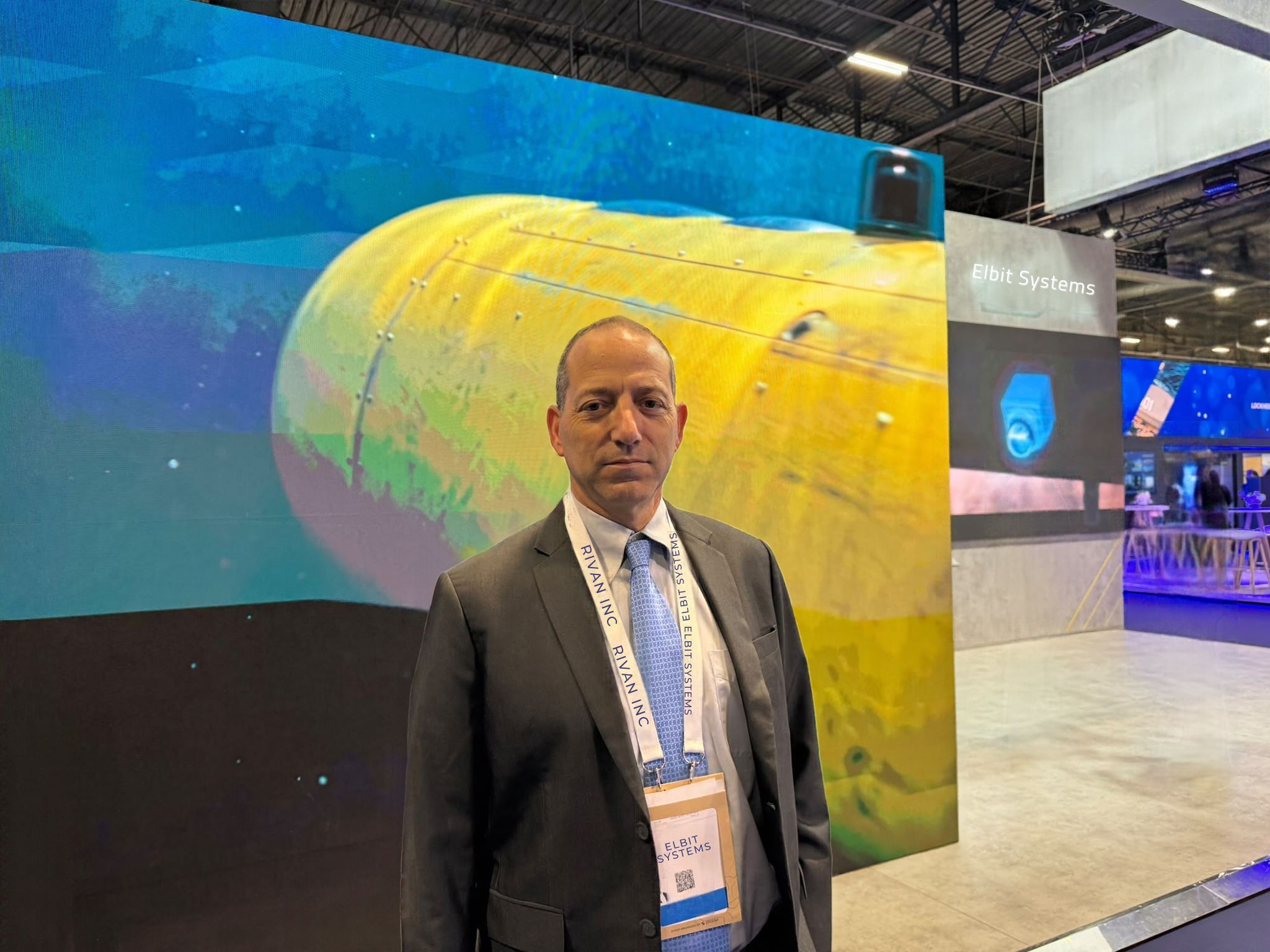
Saar Koursh, vice president of Elbit’s Intelligence and EW (electronic warfare) Division and head of the company’s naval systems sector
According to him, “Elbit began its journey in airborne systems, and today it is the largest autonomous aircraft company in the world outside the USA. The naval systems sector at the company has always been smaller, but the company wants to expand it”.
In this regard you are like the Ministry of Defense – the Israeli Navy’s budget is also meager compared with that of the Air Force and Army.
Koursh: "But around the world, navies receive enormous budgets.” In most militaries, the budget is split equally among the air force, navy and army. Elbit realized this about six years ago and decided it wanted to expand in the naval sector. You cannot neglect 30% of the business. Today, we already have a broad portfolio in this domain. We manufacture sensors and effectors (sensors and response measures, H.A.) – anything that can go on a vessel: an electro-optical payload, radar, long-range rockets, communications equipment and EW systems.
Is there a difference between your technologies, which are designed for UAVs (unmanned aerial vehicles) and those designed for USVs (unmanned surface vessels)?
There are differences in the takeoff and landing elements. It’s like comparing an F-15 fighter jet to an F/A-18 (the former is designed to take off from land bases, while the latter is launched from aircraft carriers, H.A.). There are also differences in the tools’ real-time orientation capabilities. There is a conceptual gap that leads navies to carry out only a few unmanned missions. But there is no technological gap between the army and the navy.
“The major boost that the world of unmanned vessels has received over the past four years stemmed from the war in Ukraine. Ukraine, with a negligible navy, is fighting one of the most powerful navies in the world. Nevertheless, the Ukrainians put up a significant fight against Russia, most of being implemented using unmanned vehicles. As a result, there is currently no navy in the world that isn’t working on such vessels”.
But in its 50 years of existence, ISE sold a total of just 250 vessels. That sounds like a little.
“It’s a lot. As in the world of UAVs and drones, the world of UUVs also has categories—small, medium, large, and extra-large vehicles. With this acquisition, we are entering the world of the large-scale vessels that ISE is developing. These aren’t extra-large vessels, but they reach significant depths and distances. Each such platform costs millions of dollars, and each navy buys only a few of them each year".
What depths are we talking about?
“The vehicles can dive down to a depth of 6,000 meters. Most naval missions don’t require diving deeper than 300 meters. A manned submarine dives to a few hundred meters; no one reaches thousands. For naval mine-laying missions, for example, you need to reach a depth of 100–200 meters; for ASW (anti-submarine warfare) missions, a little deeper”.
So why do we need the ability to reach a depth of 6,000 meters? To salvage the Titanic?
“For this too, and to understand what lies on the seabed, for the benefit of research institutes and universities, and primarily for warfare on the seabed, that is, to protect national infrastructures. Most oil pipelines and communication infrastructures cross oceans today. When you have a communication cable that is 2,000-3,000 meters deep, you want to monitor it, because there are people who want to sabotage this infrastructure, whether by dragging an anchor from a ship or another form of physical sabotage, as we’ve seen in the Baltic Sea.
“The nightmare scenario is that they attach explosive devices to such cables, then detonate them when the time comes, bringing down all of the world’s communications infrastructure in the process. An example of such a country is Taiwan, which is scared to death of China. The number of cables reaching each country is in the single digits, and every country wants to ensure that all this infrastructure is regularly inspected by tools that descend into the depths with a sonar that scans the infrastructure, performs imaging and provides a picture”.
What about visual photography? Do submarines use it?
“Visual capability exists, but it provides an image only from a few meters away. For deep-water areas, sonar is best, because even if some of the infrastructure is covered by sand, it can penetrate it and provide a current image”.
Besides Ukraine, the main arena for autonomous undersea warfare is the Strait of Hormuz.
“Correct. Just as no bomb disposal expert goes to defuse a bomb without sending in a robot, at sea they also send an autonomous vehicle to sweep the area, and once it locates an object suspected of being a naval mine, it dispatches an ROV – a remotely operated underwater vehicle—operated from the autonomous vessel. It descends to the seabed, physically reaches the mine, attaches a charge to it and detonates it – all managed from a control room that may be 5,000 km away.
“The problem in Hormuz is that the Iranians tried to destroy every such autonomous vessel that enters the area. UUVs, on the other hand, are almost impossible to destroy, and the company we have acquired manufactures both UUVs and ROVs”.
So the submarine doesn’t make the vessel redundant?
“The unmanned surface vehicle carries the unmanned undersea vehicle—which, while stealthy and difficult to intercept, has a limited range and low speed. It advances at a speed of 3 knots (about 6 km/h), compared with the USV’s 20 knots (about 36 km/h)”.
How long can unmanned undersea vehicles operate under the sea?
“It depends on the mission and the type of payload (intelligence device). Tens of hours to days”.
“The boost the world of unmanned vessels received came from the war in Ukraine, where Ukraine – which has a tiny navy itself – is fighting one of the most powerful navies in the world. Nevertheless, it has put up a fight against Russia, mostly using unmanned platforms. As a result, there is currently no navy that is not working on such vessels”.
And are they powered exclusively by electricity?
“In the USA, nuclear propulsion is also an option, but UUVs mostly rely on batteries, and the field is shifting toward relying on fuel cells as an energy source. Elbit owns Hydrolite (a company that manufactures hydrogen fuel cells, which enable an engine to deliver more power and weigh less than electric battery-based propulsion, H.A.), and one of the first things we will do is launch a joint program with Hydrolite to install fuel cells in our UUVs. If we use them on fuel cells, we can achieve operating times of days or weeks. ISE’s vehicles have already carried out undersea missions from 2,000 km away. A decade ago, for example, they developed a UUV designed to lay a fiber-optic cable beneath the North Pole, a task that took several weeks”.
“A naval mine costing thousands of dollars can sink ships worth hundreds of millions”
The international military market is currently saturated with companies seeking to compete in the autonomous submarine market. In Europe, Koursh identifies the French company Thales and the company Atlas, a subsidiary of Germany’s ThyssenKrupp that is collaborating with Israel Aerospace Industries in making the BlueWhale, as competitors. Alongside them in the field are Sweden’s SAAB, Norway’s Kongsberg, and many others. In the USA, the giants Lockheed Martin and Boeing are operating in the field, alongside a new name: a startup called Saronic, which raised $1.75 billion in March 2026 and is valued at $9.25 billion. An example of Saronic’s capabilities came last June, when a U.S. helicopter crashed in the Strait of Hormuz, and the two pilots aboard it were rescued by one of the company’s unmanned surface vehicles.
“Any other vessel that entered the area could have been hit by a missile”, Koursh says, referring to the rescue in Hormuz. “The Americans are currently acquiring hundreds of autonomous undersea vehicles, and the U.S. market has been moving strongly in this direction over the past two or three years. Saronic, for example, raised capital on the strength of a PowerPoint presentation, even though all it does is build unmanned surface vehicles. Traditional shipyards are also operating in the United States alongside it. When examining the competitors, it is worth noticing that almost every company in the field has a remotely controlled platform, especially platforms capable of performing ISR (intelligence, surveillance and reconnaissance). These are fitted with a simple electro-optical camera and radar to provide imagery of the area, all at a low cost. But in the autonomous field, it is only the big companies that are really present”.
What lessons have been learned from the use of autonomous platforms in the Strait of Hormuz?
“The first thing we learned is that even an unmanned surface vehicle entering the area must be protected by electronic warfare systems. The second is that every such vessel needs to be ready to operate in a GPS-denied environment and capable of navigating using other means. The third is that autonomous submarines like these need long ranges. Sometimes you launch the vehicle a great distance from the target, making synergy between UUVs and USVs necessary.
Has the war in Iran in the Strait of Hormuz revealed new developments in the field of naval mines?
“There are a variety of companies developing minelaying technology, from here to Petah Tikva. The most advanced mines can rest on the seabed, listen out for an acoustic signature above them, and then self-activate when a ship passes overhead. But most mines aren’t like that. Usually, a mine dropped into the water and anchored to the seabed is sufficient. A naval mine is fundamentally an asymmetric weapon: a munition that costs just a few thousand dollars, but can sink ships worth hundreds of millions of dollars. Historically, it is the weapon that has sunk the most watercraft. As early as the American War of Independence, when the British entered Hudson Bay, the Americans mined it.
“They are also easy to disperse – from a merchant ship, from the air or from a submarine. After you disperse them, they are difficult to find because they get carried away by currents. It is enough for whoever dispersed them to announce that they laid mines to cause the intended damage. In fact, in theory, you don't even have to actually lay the mines. If Hezbollah had said at the beginning of the war that it had laid mines in the area of Haifa Port, the premium that insurance companies would have charged ships to enter the port would have jumped tenfold. Accordingly, premiums for companies that need to cross the Strait of Hormuz have soared, even though only a few mines were actually laid there”.
The next arms race
The great advantage of UUVs is that they cost less than one-tenth of the price of manned submarines, and they avoid tying up crew members on distant missions. Where UUVs still lag behind manned submarines is their offensive capability. These are small platforms with extensive intelligence-gathering capabilities both above and below the surface, but limited firepower. However, Lockheed Martin, for example, is already showcasing autonomous undersea vehicles that can surface, launch rockets and dive back down. Additionally, foreign media has reported over the past year that the German military is relying on Elbit’s PULS multiple rocket launcher to arm autonomous vessels as part of preparations to contend with the Russian military in the Baltic Sea.
Another arena in which the need for UUVs has grown in recent years is the effort to counter the Houthis – who are blockading the Bab el-Mandeb Strait, including by using unmanned vessels that sometimes serve as explosive boats that are detonated against their targets. The ability to deploy an unmanned submarine or unmanned surface vessels against them could transform the arena and the way of dealing with them.
According to Koursh, “We know how to equip unmanned vessels with a variety of attack capabilities – from anti-submarine torpedoes to unmanned gun turrets. Elbit manufactures unmanned autocannon firing stations that fire 30 mm rounds. In the last war, the USA sank an Iranian ship by firing from a submarine. Such an event last happened during the Falklands War, 40 years ago. This field is gaining momentum”.
And what’s the next goal in the field? Will we see laser fire from a vessel?
“The Americans have already begun conducting tests firing a high-powered laser mounted on ships. They can use an aircraft carrier that has enough energy for that. Just as on land, everyone sees laser-based threat interception as more cost-effective – the same is true at sea. The next frontier for energy weapons (lasers) will be the naval domain – we’ll be able to intercept aerial threats using ship-mounted energy weapons”.
This article was written by Hagay Amit for TheMarker. We received permission to translate it. For the original article in Hebrew, Click here.