

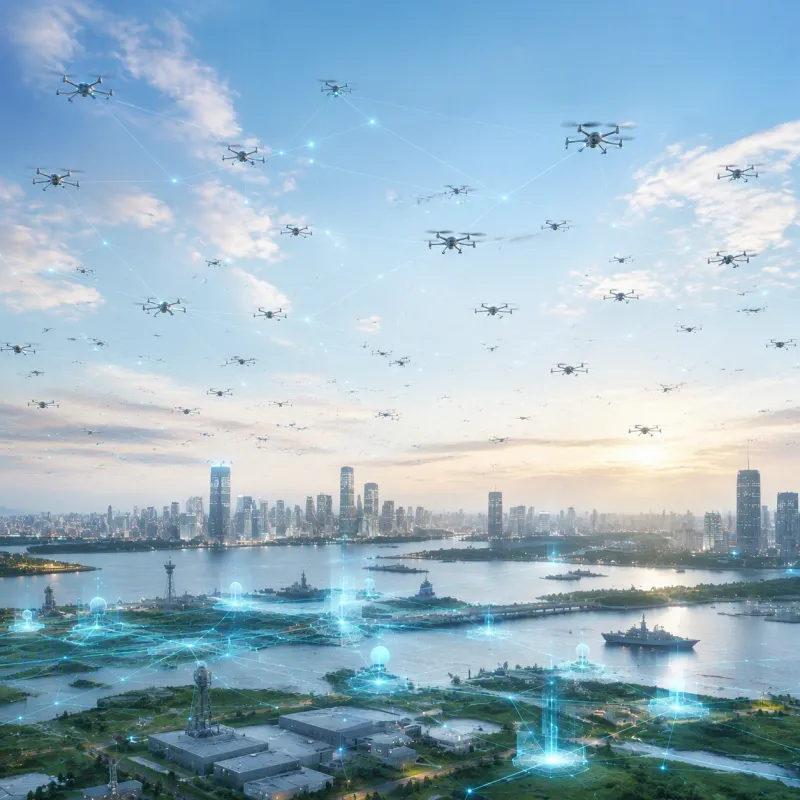
When Cheap Drones Break the Math of War
At Elbit Systems' Innovation Week, the company's CTO explored how low-cost threats are challenging traditional defense strategies and why AI and autonomous systems could fundamentally change the way wars are fought.
Key Takeaways
- Low-cost drones are challenging the economics of defense strategies built around expensive military platforms and interceptor missiles.
- Shuki expects robotic systems to take on more battlefield tasks currently performed by soldiers, while humans remain involved in decisions about the use of force.
- Defense companies must balance rapid software development with the longer development cycles required for complex military platforms.
- Large defense companies can draw on expertise across multiple disciplines to identify emerging technologies and integrate them into different systems.
Consider a military facing a swarm of inexpensive drones. A single drone may cost just a few dozen dollars, while an interceptor missile could cost millions. Even if every interception succeeds, the economic balance increasingly favors the attacker.
For Shuki, Elbit Systems' senior executive vice president and chief technology officer, this imbalance illustrates one of the most significant technological disruptions facing the defense industry.
"When the threat is a swarm of drones costing just a few dozen dollars each, you cannot intercept them with missiles costing millions. The math simply collapses," Shuki said during a conversation with Tomer Kashi, founder and CEO of VOOM and a graduate of Israel's Talpiot program.
The discussion, held as part of Elbit Systems' Innovation Week, explored how artificial intelligence, autonomous systems, and other emerging technologies are transforming defense innovation.
According to Shuki, the conflicts in Ukraine and Israel have sharpened the contrast between two approaches to warfare: costly, precision-guided weapons and large numbers of inexpensive systems capable of creating disproportionate operational challenges.
The implications extend well beyond the immediate battlefield. "The real disruption is understanding that the doctrine we've relied on for years will have to change," Shuki said. "We need new types of systems and an entirely new way of thinking strategically about asymmetric warfare."
From Individual Drones to Intelligent Systems
The growing importance of inexpensive military platforms raises a question for established defense manufacturers: how can companies specializing in complex systems compete in a world where relatively simple drones can produce significant effects?
Kashi challenged Shuki on this point, asking whether Elbit should enter the market for extremely low-cost, expendable drones.
Shuki's response focused on the distinction between producing an inexpensive platform and turning multiple platforms into an effective operational system.
"Elbit is a company that knows how to adapt, and we do it quickly," he said. "If that's what the market needs, we'll be there. But we should remember that we're a company that develops complex systems, not just a component someone orders from AliExpress and assembles in a basement."
He argued that Elbit's strength lies in adding sophisticated capabilities to relatively inexpensive hardware. "We take these low-cost platforms and give them intelligence," Shuki said. "The ability of a drone to operate autonomously, identify a target, communicate with other drones and coordinate its actions with them is where Elbit's added value comes in."
This distinction is central to the emerging role of AI in defense. Rather than treating each drone, sensor, or vehicle as an isolated product, AI-enabled systems can connect them, process shared information, and coordinate their actions.
The Battlefield in 2036
Kashi opened the conversation with a series of rapid-fire predictions about what the defense industry might look like in 2036. The exchange revealed how dramatically Shuki expects military operations to change over the next decade. He foresees robotic systems taking on a significantly greater share of battlefield tasks, without necessarily removing humans from decisions about the use of force.
Shuki also expressed confidence that quantum computing would create new capabilities, including the potential to break some widely used forms of encryption. Yet he suggested that focusing exclusively on decryption risks overlooking the broader technological possibilities of quantum computing.
His predictions reflect a larger theme running through the conversation: the coming decade will be shaped not by one technological breakthrough but by the interaction of several technologies advancing simultaneously.
A Journey with AI That Began Long Before ChatGPT
Although generative AI has become part of everyday conversation, Shuki's experience with neural networks began decades before the current wave of large language models.
After studying electrical and electronics engineering at Tel Aviv University, he served in Unit 8200 and worked on an intelligence-related development program involving the Israeli Air Force, military intelligence, and Elisra, which later became part of Elbit Systems.
He subsequently returned to academia, spending four years studying computational neuroscience at the Hebrew University of Jerusalem.
His research involved modeling neural activity and exploring computational principles underlying neural networks.
At the time, neural networks could achieve recognition rates approaching 95% on tasks such as handwriting recognition. Yet those results exposed an important limitation.
"We could reach recognition rates of around 95%, but that wasn't enough," Shuki recalled. "We couldn't take the human out of the loop." At the time, both computing power and neural-network architectures constrained the reliability of applications such as speech and handwriting recognition.
Advances in deep neural networks and, later, the emergence of foundation models, including large language models with billions of parameters, changed what the technology could accomplish.
Shuki's experience across several generations of AI development gives him a longer-term perspective on the current wave of innovation. Technologies can remain promising for years before advances in computing, algorithms, and engineering make them practical for commercial and operational use.
For a defense company, recognizing that transition at the right moment is critical.
The CTO's Challenge
As CTO of a company operating across numerous defense disciplines, Shuki must consider technologies with very different development timelines.
A military aircraft may require years of design, engineering, testing, and production. A software application can be developed and updated much faster. Both may be affected by the same technological breakthrough, but they cannot necessarily adopt it at the same pace.
"The CTO's role is to anticipate technological developments over timeframes relevant to the company, and adopt them in a way that makes our products and systems more competitive," Shuki said. The key, he emphasized, is timing. "You need to provide the technological compass at precisely the right time. I repeat that because it's extremely important."
Artificial intelligence is making that responsibility more demanding by accelerating development and shortening the time between envisioning a new capability and making it technically achievable.
Shuki described three advantages of overseeing technology across a diversified defense company: a broader view of emerging developments, the ability to identify connections between different technological disciplines, and the ability to align technologies with different development timelines.
A breakthrough originating in one field may have applications across numerous products. AI, for example, can support several different types of systems, allowing the company to draw on shared knowledge and capabilities rather than approach every challenge independently.
Important Notice: Certain blog articles may contain forward-looking statements and are not intended to provide business, financial, or investment information. Please review our full disclaimer here.